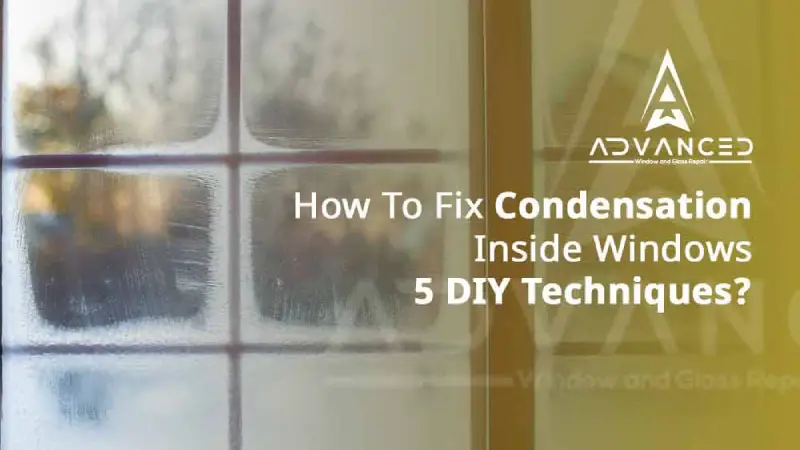
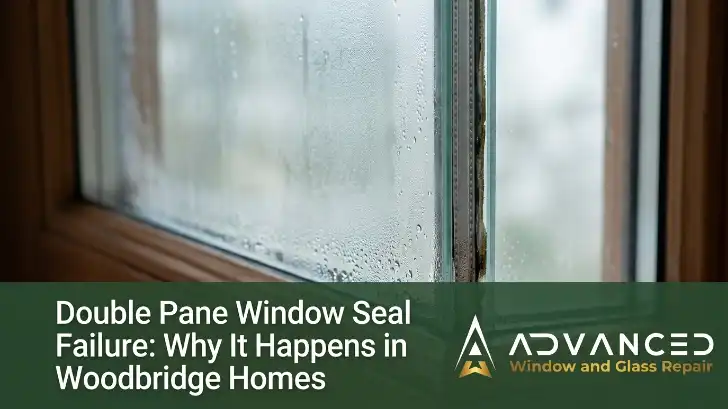
Most Woodbridge homeowners notice the fogging first. A haze between the glass panes that will not wipe off, gradually getting worse through summer and barely visible on dry winter days. It is easy to ignore. It is also a sign that the seal on the insulated glass unit has already failed and the window is losing thermal performance every day it stays that way.
Seal failure is one of the most common calls to Advanced Window & Glass Repair across Woodbridge window glass repair territory. This guide explains exactly why it happens here, how to spot it early, and what the fix actually involves.
How a Double Pane Window Actually Works
A double pane window is not simply two sheets of glass. It is a sealed unit called an insulated glass unit, or IGU. Two panes of glass are held apart by a rigid spacer bar running around the perimeter. The gap between the panes, typically between half an inch and three quarters of an inch, is filled with argon gas, which insulates far better than air alone.
The insulated glass unit components that hold this system together include two separate seals. The primary seal runs between the spacer bar and the glass on both sides. The secondary seal bonds the outside edge of the spacer assembly to the glass, providing structural strength and a second moisture barrier. Both seals work together to keep the argon gas inside and humid outside air out.
Inside the spacer bar there is a desiccant material, usually silica beads or a molecular sieve. The desiccant absorbs any trace moisture that gets past the outer seal before it can condense on the inner glass surfaces. When the seals are intact, the desiccant never gets overwhelmed. When the seals develop gaps, moisture enters faster than the desiccant can absorb it. Once the desiccant is saturated, it stops working entirely. The fogging then appears and progressively worsens as moisture builds up inside the cavity.
Why Seals Fail: The Real Causes in Woodbridge Homes
Seal failure is rarely caused by a single event. It is almost always the result of accumulated stress over multiple seasons. Woodbridge’s climate creates a specific pattern of stress that explains why IGU seals in Prince William County homes tend to fail at a faster rate than manufacturer estimates suggest.
Freeze-Thaw Cycling
Woodbridge winters regularly drop below 20°F overnight and climb above 40°F by afternoon within the same 24-hour period. Each temperature crossing of the freezing point causes every material in the window, including glass, spacer bar, sealant, and frame, to contract and then expand.
Different materials do this at different rates. The sealant is flexible enough to handle some movement, but repeated cycling fatigues it progressively. Micro-gaps develop at the bond line between the sealant and the glass edge. Once a micro-gap exists, each subsequent cycle drives it slightly wider.
Summer Humidity
Woodbridge sits near the Potomac River and the Occoquan Reservoir. Local humidity runs above the Northern Virginia average through July and August, regularly exceeding 75 to 80 percent on summer afternoons.
When humidity is high and indoor air conditioning creates a cooler interior, the pressure differential pushes warm, moist exterior air toward any gap in the seal. Even a pinhole-sized micro-gap allows moisture-laden air to enter the IGU cavity under these conditions. The desiccant begins absorbing this moisture, and the saturation process starts.
UV and Sun Exposure
Ultraviolet radiation breaks down the organic polymer compounds in window sealants. South-facing and west-facing windows in Woodbridge homes receive sustained UV load from late spring through early autumn.
The sealant on these windows becomes brittle and loses its bonding strength faster than on shaded or north-facing windows. A sealant that retains flexibility handles freeze-thaw movement without cracking. A UV-degraded sealant cracks under the same movement that a healthy seal absorbs without issue.
Poor Original Installation
Seals installed without proper surface preparation, with the wrong sealant chemistry for the frame material, or without adequate secondary seal depth will fail years ahead of schedule.
This is common in lower-cost window products installed during the Woodbridge building boom of the 1990s and early 2000s. Windows from that era are now 20 to 30 years old. Many are on their original seals, which were never designed to last this long under Northern Virginia conditions.

How to Spot Seal Failure Before It Gets Worse
Catching seal failure early keeps repair costs low. The damage is progressive. The longer a failed seal goes unaddressed, the more moisture saturates the desiccant and the worse the fogging becomes. These are the signs Advanced Window & Glass Repair looks for when assessing a window across Woodbridge and Prince William County..
Fogging between the panes is the most obvious sign. It appears as a haze, cloudiness, or streaking visible between the two glass surfaces. It does not clear when the glass is cleaned from the outside or inside. On dry winter days it may appear less prominent. On humid summer afternoons it is usually at its worst. If fogging is visible at all, the seal has already failed.
Glass distortion or waviness in certain light is an early-stage indicator. As argon escapes the unit, the pressure differential between the sealed cavity and the outside atmosphere causes the glass panes to flex slightly inward. Looking at the window at an angle from outside, the reflection will appear slightly warped compared to other windows. This can precede visible fogging by weeks or months.
Drafts at the frame when the window is fully closed indicate weatherstripping failure rather than IGU seal failure. Both can occur on the same window. If a window is both drafty and foggy, the IGU and the frame weatherstripping both need attention. Can double pane windows be repaired covers how technicians assess which component has failed before recommending the appropriate repair.
What Happens If Seal Failure Is Left Unaddressed
Most homeowners put off dealing with a foggy window because it seems like a cosmetic issue. It is not. A failed seal changes how the window performs thermally and structurally over time.
The argon gas that provided the insulating performance of the window has escaped or is escaping. The cavity is now filled with ordinary air, which transfers heat and cold far more efficiently than argon. The Department of Energy’s guidance on home window energy performance documents the measurable difference in heat transfer between properly sealed and failed IGUs. A window that once provided a U-factor of 0.30 or better is now performing closer to an uninsulated single-pane unit.
As moisture continues to accumulate inside the cavity, it does not stay as vapour. Mineral deposits from the moisture begin forming on the inner glass surfaces. These deposits are white or grey residue that becomes permanent over time. Once mineral deposits have formed, replacing the IGU will not fully restore optical clarity. The deposits are on the glass surfaces themselves and cannot be cleaned from the outside. This is the point at which an IGU replacement becomes urgent rather than optional.
Your Repair Options When a Seal Has Failed
When the seal has failed and fogging is confirmed, there are two repair paths. Advanced Window & Glass Repair assesses the frame condition first before recommending either one.
IGU replacement is the right option when the frame is structurally sound. The failed glass unit is removed from the existing frame and a new factory-sealed, argon-filled unit is installed in its place. The frame, sash, hardware, and trim all remain. This restores full thermal performance and eliminates the fogging. For a full technical breakdown of the process, the complete guide to double pane window repair covers every step from assessment through installation.
Full window replacement becomes necessary when the frame has rotted, cracked, or warped to the point that it cannot reliably hold a new IGU. A frame in structural failure will allow the new unit to shift, which stresses the new seal immediately and leads to premature failure. Replacing the IGU inside a failing frame does not solve the problem.
If a pane within the unit has cracked or broken from impact, the repair path is different. Repair broken glass in a double pane window covers how a cracked pane is handled separately from a failed seal. The assessment and parts involved are not the same, even though both present as damaged double pane windows.
| Factors | IGU Replacement | Full Window Replacement |
|---|---|---|
| Frame condition required | Structurally sound | Any condition |
| What is replaced | Glass unit only | Frame, sash, glass, and hardware |
| Typical cost (Woodbridge) | $175 to $400 per window | $450 to $900+ per window |
| Restores thermal performance | Yes | Yes |
| Appropriate for | Woodbridge homes 10 to 25 years old | Frames with rot, warping, or hardware failure |
Not sure whether the frame is sound enough for IGU replacement? Advanced Window & Glass Repair provides free phone estimates across Woodbridge and Prince William County. Call (571) 351-3692 or contact us to describe what you are seeing. A technician will tell you honestly which repair applies before any work is scheduled.
How Long Should a Double Pane Window Seal Last in Woodbridge
The standard manufacturer estimate for IGU seal life is 10 to 20 years. In Woodbridge and Prince William County, that estimate is optimistic for several reasons.
The freeze-thaw cycle frequency in this climate exceeds what most manufacturers test to. A window rated to handle 20 years of typical mid-Atlantic weather will reach that stress threshold faster in Woodbridge than in a coastal Virginia or inland Piedmont location. The combination of hard freeze winters, high-humidity summers, and UV load on south and west-facing windows means seals on exposed elevations can begin failing at 12 to 15 years on lower-quality units.
Higher-quality IGUs with dual-seal construction, warm-edge spacer bars, and UV-resistant sealant consistently outperform the 20-year estimate in this climate. Aluminium spacer bars conduct temperature efficiently, concentrating thermal stress at the seal bond line. Foam or fibreglass spacer bars reduce this concentration and extend seal life measurably.
The double pane window service process at Advanced Window & Glass Repair always includes an assessment of the spacer bar construction before recommending a replacement specification, because repeating the same specification repeats the same failure timeline.
Conclusion
Seal failure in Woodbridge double pane windows follows a predictable pattern. Freeze-thaw cycling weakens the seal bond over multiple winters. Summer humidity drives moisture through the micro-gaps that develop. UV exposure accelerates sealant degradation on south and west-facing elevations. The fogging appears once the desiccant is saturated, usually months or seasons after the seal actually failed.
The repair in most cases is an IGU replacement, not a full window replacement. The frame condition is the deciding factor. A sound frame means the glass unit is replaced inside it at a fraction of full replacement cost. A failing frame means the full window needs addressing. Either way, the assessment comes first and the recommendation follows from what the frame actually shows.
Advanced Window & Glass Repair has handled this assessment across Prince William County since 1999. Every job starts with an honest look at the frame before any quote is given.
Don’t Wait Until the Deposits Form Serving Woodbridge and Prince William County since 1999. Call (571) 351-3692 or contact us for a free phone estimate. Same-day availability. Repair-first, always.
Frequently Asked Questions
Why is my window foggy between the panes but only sometimes?
The fogging varies with humidity and temperature. On humid days, moisture condenses more visibly on the cooler inner surfaces. On dry days, it evaporates back into vapour and the fogging appears lighter. The seal has still failed either way. The variability does not mean the problem is intermittent. It means the desiccant is not yet fully saturated.
Can the seal be repaired without replacing the glass unit?
No reliable method restores a failed IGU seal to factory performance. Defogging services drill small holes, inject a drying agent, and install vents. This temporarily reduces fogging but does not restore argon fill or insulating performance. It also voids most manufacturer warranties. IGU replacement is the only repair that restores full performance.
How do I know if it is the seal or the weatherstripping causing the draft?
Fogging between the panes points to IGU seal failure. Drafts at the frame perimeter with the window fully closed point to weatherstripping failure. Both can occur on the same window. A lit candle held near the frame perimeter on a cold day will show air movement at a weatherstripping gap. A technician can determine whether one or both repairs are needed in a single assessment.
Do Woodbridge homes from the 1990s have worse seal problems than newer builds?
Yes, for two reasons. Windows from the 1990s Woodbridge building boom used aluminium spacer bars and single-component sealants that perform poorly under freeze-thaw stress. They are also now 25 to 30 years old, well beyond the typical 10 to 20 year seal lifespan. Homes built after 2005 used improved dual-seal IGU construction and warm-edge spacer materials that hold up better under Northern Virginia conditions.
What is the cost difference between IGU replacement and full window replacement in Woodbridge?
IGU replacement in Woodbridge typically costs between $175 and $400 per window. Full window replacement runs $450 to $900 or more. For a home with five foggy windows and sound frames, IGU replacement saves $1,500 to $3,000 compared to full replacement while delivering the same thermal and visual result.