
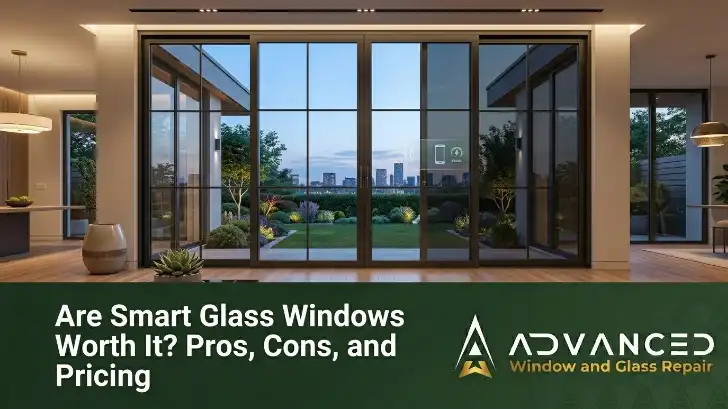
Smart glass windows are drawing serious attention from property owners looking to manage privacy, reduce glare, and cut energy costs without bulky window treatments. The upfront cost is substantial, and the right application matters.
Advanced Window & Glass Repair, a specialist in glass replacement across Northern Virginia, has evaluated smart glass projects throughout the region and knows exactly where this technology delivers value. This guide covers everything needed to make a confident decision.
What Is Smart Glass Windows?
Smart glass, also called switchable glass, is a type of glass that transitions between transparent and opaque states on demand. The switch is triggered by an electrical signal, a remote, or a smart home system. The result is a window that works as both a clear pane and an instant privacy screen. No blinds or curtains are needed.
In the right application, the technology replaces all traditional window coverings. Rather than pulling a shade or closing a blind, the occupant adjusts the glass directly from a wall switch or a smartphone app. This eliminates physical window treatments and produces cleaner, more minimal interiors.
Smart glass is available for residential windows, commercial glazing, skylights, shower enclosures, and glass partitions. Each application has different requirements, and pricing varies by technology type and total glass area.
Smart Glass Technology Types
Two primary technologies are used in smart glass today: electrochromic glass and PDLC (Polymer Dispersed Liquid Crystal) glass. Each operates differently and suits different applications. Homeowners and businesses can discuss which type fits their project with the glass repair and replacement specialists in Northern Virginia.
Electrochromic Glass
Electrochromic glass tints gradually when a low-voltage electrical current is applied. The transition takes several minutes and moves smoothly from clear to a tinted state. This gradual change suits large commercial windows where controlling solar heat gain is the primary goal. The glass does not become fully opaque, so views are maintained even at full tint.
PDLC (Polymer Dispersed Liquid Crystal) Glass
PDLC glass switches instantly between clear and fully opaque states when voltage is applied. This suits bathrooms, conference rooms, and home offices where immediate privacy is needed. Without power, PDLC glass defaults to opaque. With power applied, it turns clear.
How Smart Glass Windows Function
Smart glass works by changing a thin coating when an electrical current is applied. In electrochromic glass, ions move through a coating and change how much light the glass transmits. In PDLC glass, liquid crystals align or scatter based on whether voltage is applied.
Both types connect to standard wiring and work with smart home or building management systems. Occupants control the glass via wall switches, remotes, or smartphone apps. Advanced Window & Glass Repair recommends involving both a qualified glazing contractor and an electrician from the planning stage, since smart glass installation requires both trades to work in sequence.
The performance of smart glass depends on how well the unit is made and sealed. A poorly made panel will fail early, regardless of how good the control hardware is.
Advantages of Smart Glass Windows
Smart glass offers several meaningful advantages for the right application:
| Benefit | Why It Matters |
| Instant privacy | Switches from clear to opaque with no physical window covering required |
| Reduced glare | Lowers incoming solar radiation, improving comfort at screens and work surfaces |
| Energy efficiency | Reduces cooling load by limiting solar heat gain through the glass |
| Modern design | Removes clutter from window areas, producing clean, unobstructed interiors |
| Smart integration | Connects with home and building automation systems for scheduled or automated control |
The privacy benefit is the most frequently cited reason for choosing smart glass. In bathrooms, meeting rooms, or street-facing windows, the ability to switch between clear and opaque without installing curtains or blinds is a genuine practical advantage that simplifies the interior over the long term.
Cons of Smart Glass Windows
There are real limitations to smart glass that should be assessed before committing to the investment:
| Drawback | Consideration |
| Higher upfront cost | More expensive than traditional glass windows. |
| Electrical dependency | Requires a constant power source to operate, which may pose a challenge in certain situations. |
| Limited repair options | Specialized repair services may be required in case of malfunctions or damage. |
| Installation complexity | Professional installation is needed, which can increase both time and costs. |
The cost gap is the most significant barrier. Smart glass runs $50 to $150 per square foot before installation, compared to $15 to $35 per square foot for standard double-pane glass. A full home conversion can easily exceed $10,000 to $20,000 in total cost. Advanced Window & Glass Repair advises clients to obtain detailed quotes covering both glazing and electrical components before any commitment is made.
Smart Glass Window Pricing
The total cost of smart glass depends on the technology chosen, total glass area, and installation complexity.
Typical Costs
- Basic PDLC smart glass: $50 to $100 per square foot for the glass panel, before installation.
- Electrochromic glass: $100 to $150 per square foot, reflecting the more complex manufacturing process.
- Installation and electrical work: $30 to $60 per square foot on top of the glass cost, depending on wiring complexity and framing requirements.
A single residential window (about 15 square feet) typically costs $1,200 to $3,200 fully installed. Larger projects require a detailed quote based on exact dimensions and control requirements.
The initial cost can be partially offset by eliminating window treatments over time. A set of motorised blinds for a single room can cost $800 to $2,000 installed. Across a full home, removing the need for treatments reduces the net cost gap between smart glass and traditional options.
Properties across Northern Virginia are increasingly requesting smart glass consultations. Our team can assess whether a smart glass application makes sense before any commitment is made. Call (571) 351-3692 or visit the contact page to book a free consultation.
Are Smart Glass Windows Energy Efficient
Smart glass windows reduce solar heat gain, helping to stabilise indoor temperatures and reduce reliance on air conditioning. In settings with high solar exposure, this impact is measurable.
Potential Energy Savings
Studies on electrochromic glass show cooling demand reductions of 15 to 25 percent in buildings with high glazing ratios. Actual savings in a residential home depend on window orientation, local climate, and how frequently the glass is operated in its tinted or opaque state.
For Northern Virginia properties with south or west-facing windows that receive direct afternoon sun, smart glass can meaningfully reduce heat gain during summer months. The effect is smaller in shaded properties or those with existing low-E coatings.
Smart Glass Windows in Homes vs Offices
Smart glass performs differently depending on the setting, the frequency of use, and the specific privacy or light-control needs of the space.
Residential Use Cases
- Bathrooms: The privacy function replaces frosted or textured glass and allows the space to feel larger when the glass is in its clear state.
- Bedrooms: Opaque mode functions as a blackout option, useful for shift workers or east-facing rooms.
- Sunrooms: Tinting control makes sunrooms usable year-round by limiting heat gain during summer afternoons.
- Street-facing windows: Opaque mode provides privacy from passing traffic or neighbouring properties without adding curtains.
Commercial Use Cases
- Conference rooms: Instant privacy for meetings without installing partition walls or curtains.
- Office partitions: Light levels adjust to reduce screen glare while maintaining an open, connected feel.
- Healthcare settings: Patient privacy is maintained alongside natural light, which benefits recovery environments.
- Retail spaces: Displays and interiors can be revealed or concealed on demand for promotional purposes.
How Smart Glass Compares to Traditional Window Treatments
Smart glass is frequently evaluated against motorised blinds, electric frosted film, and static frosted glass. Each option has a different cost, lifespan, and maintenance profile.
Motorised blinds cost $200 to $600 per window installed and integrate with smart home systems. They provide solid light control and privacy but need periodic cleaning and motor replacement over time. They do not reduce solar heat gain as effectively as tinted smart glass.
Static frosted glass provides permanent privacy at a lower cost ($20 to $50 per square foot) but cannot switch to clear. Once installed, it stays opaque. This makes it unsuitable for rooms where natural light and views are also desired at other times.
Electric frosted window film applies to existing glass and switches between clear and opaque like PDLC glass. It costs $50 to $100 per square foot installed, making it more accessible than a full smart glass replacement. Film degrades faster than manufactured smart glass panels and typically carries a shorter warranty.
When privacy control and low maintenance are both priorities, smart glass outperforms all three over time. For straightforward privacy needs without a light-control requirement, frosted glass or motorised blinds remain more cost-effective.
Are Smart Glass Windows Worth the Investment?
Smart glass delivers the strongest return in specific, well-defined applications. The investment is justified when privacy control is a genuine requirement, the property has high solar exposure, and the aesthetic improvement has real value to the occupant or tenant.
The investment is harder to justify for standard residential windows in rooms that already have adequate coverings, windows facing north with little direct sun, or projects where the full installation cost exceeds 10 to 15 percent of the property value without a clear premium benefit.
Smart glass delivers the clearest value in high-use commercial spaces: conference rooms, healthcare, and hospitality. High-end residential properties where design quality is a core requirement are the other strong use case. For a mid-range home, the cost difference between smart glass and quality motorised blinds is difficult to recover through energy savings or resale value alone.
How Long Do Smart Glass Windows Last
Electrochromic glass panels from established manufacturers carry 10 to 15 year warranties and are built to last 20 to 25 years under normal use. PDLC film-based systems degrade faster, typically lasting 10 to 15 years before performance declines.
The glass panel itself is rarely the primary failure point. The control electronics, the edge seal of the glazing unit, and the wiring connections are the components most likely to require attention over time. A failed edge seal lets moisture in and compromises performance, the same failure seen in standard double-pane units.
Upkeep is minimal. The glass surface cleans like standard glass, and the control system requires no regular servicing. Electrical connections should be checked every five to seven years as part of routine building maintenance.
What to Ask Before Having Smart Glass Installed
A thorough check before committing to smart glass prevents costly surprises later.
Does the existing window framing support smart glass? Smart glass panels are heavier than standard glass and require robust framing. Older timber frames may need reinforcement before installation can proceed.
Is the electrical infrastructure in place? Each smart glass panel requires a wired connection to a controller. Running new wiring through finished walls adds significant cost and disruption.
What warranty does the glazing unit carry? A minimum of 10 years on the glazing unit and 5 years on the control system is a reasonable benchmark for a quality product. Shorter warranties point to lower-grade manufacturing.
Does the installer have experience with both glazing and smart glass control systems? Smart glass installation needs skill in both glass work and electrical work. The Windows & Daylighting research group at Lawrence Berkeley National Laboratory publishes independent technical guidance on dynamic glazing performance that serves as a useful reference when assessing specifications and contractor claims.
What is the glass behaviour during a power outage? PDLC glass defaults to opaque without power. Electrochromic glass holds its last tint state. The default state should suit the needs of the specific space.
Professional Recommendation Summary
Smart glass windows are a well-engineered technology that performs well in specific applications. Commercial conference rooms, high-end residential bathrooms, healthcare facilities, and properties with high solar exposure are the strongest candidates. For standard residential use, the cost-to-benefit ratio is harder to justify unless design quality and premium finish are explicit priorities.
The technology requires professional installation by contractors experienced in both glazing and electrical work. A rushed or under-specified installation will underperform regardless of the quality of the glass itself.
Conclusion: Should You Choose Smart Glass?
Smart glass is not the right choice for every project, but in the right application it replaces multiple window treatments, reduces long-term maintenance, and delivers a level of control that no curtain or blind can match. The decision comes down to the specific room, the level of solar exposure, and whether the design goals justify the cost.
Advanced Window & Glass Repair works with residential and commercial clients across Northern Virginia to evaluate glazing options with honesty. For those exploring high-performance glass technology further, the guide on insulated glass units covers the performance fundamentals that underpin all quality glazing projects.
Advanced Window & Glass Repair serves property owners across Northern Virginia, Maryland, and Washington DC with professional glass installation, replacement, and consultation services. Call (571) 351-3692 or visit the contact page to book an assessment today.
Frequently Asked Questions
1. How much does smart glass cost per square foot for a typical home installation in Northern Virginia?
Smart glass costs between $50 and $150 per square foot for the glass panel itself, depending on the technology type. PDLC glass tends to sit in the $50 to $100 per square foot range, while electrochromic glass runs $100 to $150 per square foot due to its more complex manufacturing process.
Installation and electrical work adds another $30 to $60 per square foot, depending on the condition of the existing framing, the complexity of the wiring run, and whether the control system requires new wiring or can integrate into existing smart home infrastructure.
For a Northern Virginia homeowner replacing a typical 15 square-foot residential window, the all-in cost including glass, installation, and electrical work typically falls between $1,200 and $3,200. A full bathroom conversion with multiple panels could run $5,000 to $10,000 or more depending on the total glass area.
These figures represent a substantial premium over standard double-pane glass, which costs $15 to $35 per square foot installed. The premium is justified when privacy control, solar heat management, or a specific design outcome is a genuine priority for the space. For general-purpose residential windows, the cost gap is difficult to recover through energy savings alone. Always obtain itemised quotes that separate the glass cost, the electrical cost, and the control system cost before comparing proposals from different contractors.
2. What is the difference between electrochromic glass and PDLC smart glass, and which is better for a home?
Electrochromic glass and PDLC glass achieve the same result through different mechanisms, and each has distinct strengths. Electrochromic glass tints gradually, taking several minutes to shift from clear to a darkened state. It does not become fully opaque, so it is better suited to controlling glare and solar heat gain than providing instant, complete privacy. Commercial buildings with large glazed facades commonly use electrochromic glass for this reason.
PDLC glass switches in under a second between fully clear and fully opaque, making it the better choice when privacy on demand is the primary goal. Bathrooms, bedroom windows, and home office partitions benefit most from PDLC. The instant switch means there is no waiting period, and the glass can be operated as frequently as needed without degrading its switching speed.
For most residential applications, PDLC is the more practical choice. The instant privacy function is genuinely useful in daily use, whereas the gradual tinting of electrochromic glass suits professional environments where a smooth, controlled aesthetic is valued over speed. One practical note: PDLC glass defaults to opaque when power is off, which means a power outage will obscure any windows or partitions that were in clear mode. This behaviour should be considered when selecting which windows to upgrade.
3. Does smart glass actually save money on energy bills, or is it primarily for privacy and aesthetics?
Smart glass does produce measurable energy savings in the right conditions, but the primary practical benefit for most homeowners is privacy and design rather than energy cost reduction alone. The energy savings are real but need to be assessed in context.
Research on electrochromic glass in commercial buildings with extensive south or west-facing glazing has documented cooling demand reductions of 15 to 25 percent compared to standard clear glass. These figures come from settings where large areas of unshaded glass create significant solar heat gain. The results are less dramatic in a standard home with moderate window area and existing low-E coatings.
For a Northern Virginia home with south-facing windows that receive strong afternoon sun and no existing shading, smart glass can reduce summer cooling costs by a meaningful amount. For a north-facing window or a room that already has exterior shading or high-performance coatings, the energy impact is much smaller.
The realistic way to evaluate the energy case is to consider smart glass alongside other interventions: adding external shading, upgrading to triple-pane low-E glass, or improving insulation. In most residential contexts, those alternatives deliver a better return on energy investment per dollar spent. Smart glass is worth serious evaluation when the privacy and design benefits are also valued, since those benefits cannot be achieved the same way by any other glazing option.
4. Can smart glass be installed in existing windows, or does the entire window frame need to be replaced?
In most cases, a full window replacement is required when installing smart glass, rather than just swapping the glass. Smart glass panels are thicker and heavier than standard glass, and they require wiring connections at the edge of the panel that standard window frames are not designed to accommodate. Fitting smart glass into an existing frame is technically possible in some circumstances, but it requires careful assessment of the frame’s structural capacity and the routing of electrical conduit.
The more accessible alternative for properties where full window replacement is not practical is smart glass film, also called switchable film or electric privacy film. This product applies to the interior surface of existing glass and converts the window to a PDLC-style switchable surface. Film costs $50 to $100 per square foot installed and works through the same liquid crystal technology as PDLC glass, though the clarity and longevity of film is generally lower than a manufactured smart glass unit.
For new construction or a full window renovation, specifying smart glass from the outset is the most cost-effective and technically sound approach. The framing, electrical rough-in, and glazing work can all be coordinated in a single installation phase, avoiding the additional labour cost of retrofitting.
Always confirm with the installer whether the existing frame can be retained before planning a retrofit project. A structural and electrical assessment of the current window opening is a reasonable first step before any purchasing decisions are made.
5. What happens to smart glass windows during a power outage?
The behaviour of smart glass during a power outage depends on which technology is installed, and this is an important consideration when selecting the type for a specific application.
PDLC glass defaults to its opaque state when power is removed. This is because the liquid crystal particles scatter light randomly without an applied voltage, producing the frosted appearance. When the power comes back on, the glass returns to its last programmed state. The practical implication is that any PDLC windows or partitions that were in their clear state during a power outage will switch to opaque until power is restored. For a bathroom or conference room partition, this is generally acceptable. For a living room window facing a garden or a view, a sudden loss of transparency during an outage may be disruptive.
Electrochromic glass behaves differently. Once tinted to a particular level, it holds that tint state without requiring a continuous power supply. Power is only needed when a change in tint level is requested. An outage therefore leaves electrochromic glass at whatever tint level it was last set to, which is a more neutral result than switching to opaque.
For properties in areas with frequent power outages, electrochromic glass is the more tolerant option. For applications where the opaque default during an outage is acceptable or even desirable, PDLC remains the practical choice for its instant switching speed and complete privacy coverage.
6. Is smart glass worth the cost for a residential bathroom or bedroom?
A residential bathroom is arguably the strongest use case for smart glass in a home setting. Bathrooms often require privacy but also benefit from natural light, and the standard solutions involve either permanently frosted glass that blocks views permanently, or a window covering that requires touching and maintenance. Smart glass eliminates both compromises: the glass is clear when privacy is not needed and opaque on demand.
For a typical bathroom window of 8 to 12 square feet, the installed cost of PDLC smart glass runs $600 to $2,400 depending on the glass specification and wiring complexity. This is a meaningful investment for a single window, but it removes the need for blinds, frosted film, or textured glass and provides a result that no other single product can replicate.
For a bedroom, the case is more context-dependent. Homeowners who value a blackout option alongside privacy, and who prefer not to install and maintain blackout curtains or motorised blinds, will find smart glass practical. The opaque state is not equivalent to a full blackout blind for light exclusion, as some light still passes through in the opaque state depending on the glass specification. For complete darkness, a dedicated blackout treatment remains more effective.
The general assessment is that smart glass is worth serious consideration for a bathroom in a renovation or new build where the design brief values clean, minimal interiors. For a bedroom, evaluate whether the opaque state provides sufficient darkness before committing to the product.


