
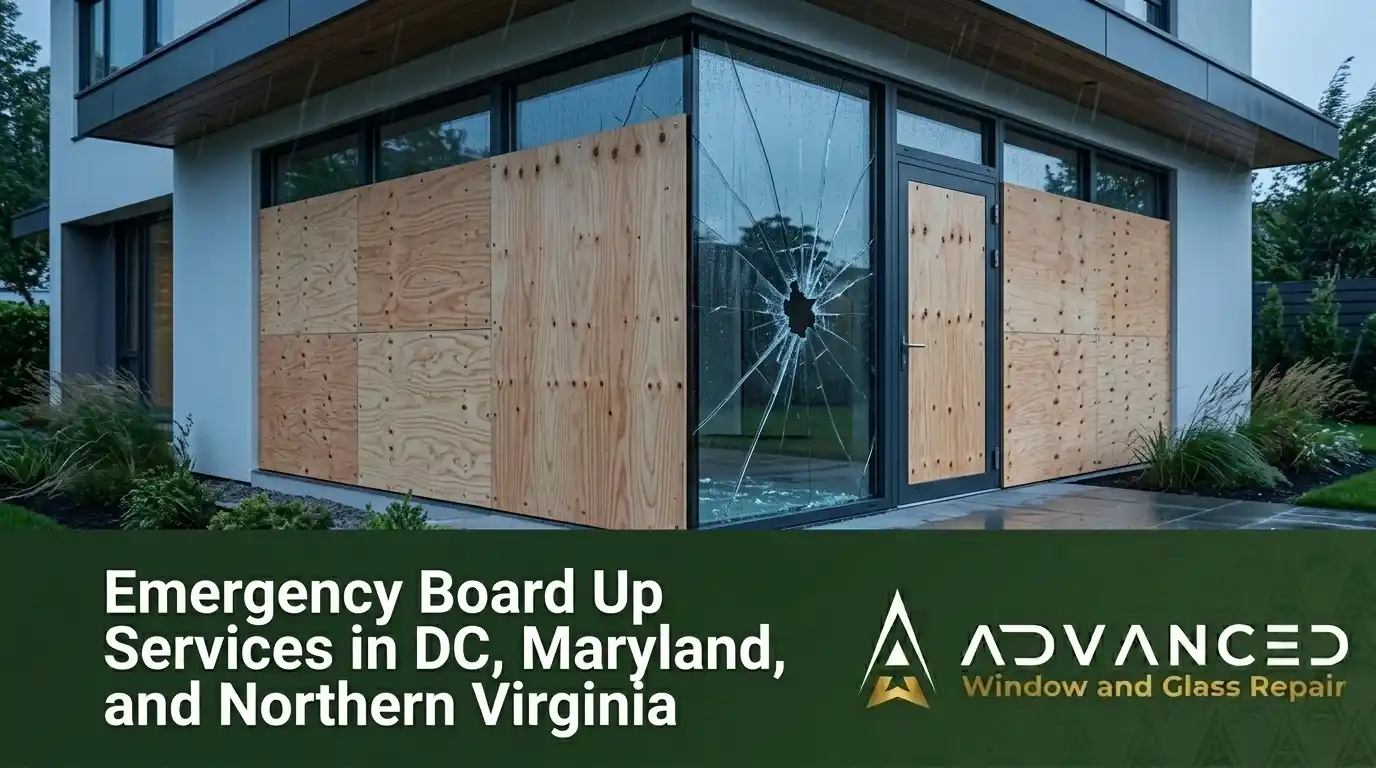
What do you do when a storm shatters a window at 2 AM? When a break-in leaves the back door wide open?
When fire leaves a commercial storefront exposed to the street? Emergency board up services secure damaged property fast, keeping out weather, intruders, and further loss until permanent repair is possible.
Advanced Window & Glass Repair has provided 24/7 emergency board up across the DMV since 1999. As an NGA-certified glass company with four offices, the team serves Northern Virginia, Maryland, and Washington DC.
This guide covers what to expect, what it costs, and how the process works for emergency glass repair in Northern Virginia and the wider DC region.
When You Need Emergency Board Up Services
Emergency board up is for situations where damaged glass or doors create immediate risk to the property. Five scenarios drive most board up calls in the DMV.
Storm damage. High winds during summer thunderstorms and the occasional Atlantic hurricane track through the DMV every year. Tree branches, flying debris, and pressure differentials can shatter windows on any floor.
The June 2012 derecho that swept across Northern Virginia and Maryland produced thousands of property damage claims in a single night. The Ready.gov severe weather guidance covers what homeowners and business owners should do during these events.
Break-ins and forced entry. Smashed front windows, kicked-in patio doors, and broken side windows are the most common entry points for residential burglary. Police reports require the property to be secured before officers leave the scene.
Fire damage. Even a small kitchen fire frequently breaks adjacent windows from the heat or from emergency response cutting access. The damaged windows leave the structure exposed to weather and looters during the restoration period.
Vehicle impact. Cars striking storefronts, garage doors hit by parked vehicles, and accidental impact on commercial glass all create immediate emergency board up situations across the DC region.
Vandalism. Smash-and-grab incidents, targeted vandalism in commercial corridors, and property damage during civil unrest all leave openings that need to be secured before further loss occurs.
How Fast Should an Emergency Board Up Crew Arrive?
Response time is the single most important measure of an emergency board up provider. Damaged property loses value every minute it sits open.
In the DMV, professional providers typically respond within 60 to 90 minutes from the call. Crews based in Northern Virginia can often reach Woodbridge, Fairfax, Springfield, McLean, and Arlington within 30 to 45 minutes.
Washington DC response runs 45 to 75 minutes from a Northern Virginia base depending on traffic and time of day. Maryland response varies more widely because of distance, with Silver Spring and Bethesda within an hour and Annapolis or Baltimore typically 75 to 120 minutes.
After-hours response (between 6 PM and 6 AM, weekends, holidays) usually carries the same response time commitment but a higher labor rate. Providers that staff overnight crews, rather than relying on on-call rotations, deliver more consistent arrival times during the riskiest hours.
A live phone answer rather than voicemail at the time of the initial call is the strongest signal of a real 24/7 operation. Providers that route after-hours calls to voicemail or callback queues are not equipped to deliver true emergency response.
Board Up Services for Commercial Properties
Business properties have different board up needs than homes. Storefronts, offices, restaurants, and retail spaces face bigger security stakes. Glass openings are larger. Insurance claims have more steps. Advanced Window & Glass Repair handles commercial board up alongside commercial storefront glass repair for the full restoration cycle.
Commercial board up scenarios most common in the DMV include:
Storefront break-ins. Smash-and-grab on street-level retail glass is the most common business call. The board holds the property secure until new tempered glass is made. Custom storefront glass takes 5 to 7 business days to make.
Vehicle impact. A car driving into a business entrance creates both glass damage and frame damage. The board addresses the glass while structural repair proceeds separately.
Storm damage to large openings. Curtain wall systems, full-height storefront glass, and skylights face higher wind than home windows. Damage on these systems usually needs custom-made glass.
Vandalism in commercial corridors. Repeat vandalism in some DC and DMV business areas drives owners to install security shutters or polycarbonate panels behind the main glass for ongoing protection.
Commercial board up often uses larger plywood panels, requires forklift or boom access for upper-story openings, and works with commercial insurance policies that need specific paperwork.
Emergency Board Up Materials
Most emergency boards up across the DMV use one of four materials, each suited to different scenarios.
3/4-inch CDX plywood. The standard residential and commercial board up material. CDX-grade plywood holds up to moisture during the boarded period, which is typically 30 to 90 days. Cost runs $30 to $50 per sheet at material price.
OSB (Oriented Strand Board). A cheaper plywood alternative, OSB runs $15 to $25 per sheet. It works fine for short-term board up but does not hold up as well in long weather exposure. Some business customers pick OSB for short jobs where looks do not matter.
Polycarbonate sheet (Lexan). Transparent polycarbonate is used on storefronts and commercial windows where maintaining visibility into the property matters. A shop that wants to stay open during board up can use polycarbonate to keep the storefront visible. Material cost is significantly higher at $150 to $300 per panel.
Steel security panels. Used in high-vandalism areas and for properties with repeated security incidents. Steel panels are mounted to the frame with security fasteners and provide stronger physical barrier than wood. Most often used on business sites in DC commercial blocks with ongoing security concerns.
The right material depends on the scenario, the duration before permanent repair, the visibility requirements, and the security level needed.
Property damaged and exposed right now? A live operator is on the line 24 hours, 7 days, every day. Call (571) 351-3692 for fastest dispatch across Northern Virginia, Maryland, and Washington DC.
Emergency Board Up in Washington DC
Washington DC is the highest-volume emergency board up market in the DMV, with concentrated commercial corridors, dense residential neighborhoods, and weather exposure. Advanced Window & Glass Repair responds across all DC quadrants and works regularly in:
Capitol Hill: Historic rowhouses, retail along Pennsylvania Avenue and Barracks Row, government-adjacent commercial properties.
Georgetown: Federal-period brick rowhouses with original window openings, M Street retail.
Adams Morgan: Mixed residential and commercial along 18th Street, frequent storefront calls..
U Street Corridor: Restaurant row, retail glass, late-night commercial activity.
Federal Triangle: Government buildings, hotel commercial frontage.
NoMa and H Street: Mixed-use development, modern commercial glass systems.
Navy Yard and Capitol Riverfront: New construction, large glass openings, retail.
Dupont Circle, Logan Circle, Foggy Bottom: Embassy properties, professional offices, residential.
DC response time from a Northern Virginia base typically runs minutes depending on traffic, time of day, and the specific quadrant. Late-night response times are usually faster than rush-hour responses.
The DC Metropolitan Police often request board up confirmation before clearing the scene of a break-in. This makes rapid response a practical necessity rather than just a convenience.

Emergency Board Up in Maryland
Maryland coverage spans from the inner DC suburbs to the Chesapeake Bay region. Different parts of Maryland present different emergency board up patterns.
Silver Spring, Bethesda, Rockville, Chevy Chase: DC-adjacent Maryland with patterns similar to Northern Virginia. Response time from a Woodbridge or Fairfax base runs 60 to 90 minutes depending on the I-495 conditions.
Annapolis: The state capital and Chesapeake Bay-influenced weather patterns make Annapolis a particular emergency board up market. Coastal storms, Bay-driven flooding, and historic district properties all create unique board up scenarios. Response time runs 90 to 120 minutes from a Northern Virginia base.
Baltimore: Urban density, commercial storefronts in historic neighborhoods like Fells Point and Federal Hill, and a mix of residential rowhouses and commercial properties. Response time runs 90 to 120 minutes.
Frederick, Bowie, Laurel: Mixed suburban and small-town markets with primarily residential and small commercial board up needs.
Maryland insurance claim processes generally follow similar patterns to Virginia and DC, but specific paperwork rules vary by carrier. The board up provider should always supply detailed photos, written scope, and itemized invoicing for the claim file.
Fire Damage Board Up
Fire damage board up has specific requirements that differ from storm or break-in board up. Even a small fire breaks adjacent glass from heat exposure and creates secondary damage from emergency response activity.
The board up after a fire must address:
Multiple openings simultaneously. Fire damage rarely affects a single window. Heat exposure breaks adjacent windows on the affected floor, and emergency response sometimes breaks windows for ventilation access. A single residential fire often produces 4 to 8 board up openings.
Smoke and water-damaged frames. Frames that have been heat-stressed, smoke-impregnated, or saturated by fire suppression water need different board up techniques than dry, undamaged frames. Standard plywood fasteners can fail in compromised wood.
Working with restoration crews. Fire restoration crews need to enter the property for water removal, smoke cleanup, and damage checks. The board up must allow restoration access while still keeping out intruders and weather.
Extended duration. Fire repair typically takes 30 to 90 days or longer based on damage extent. Board up materials must hold up to that timeline, which leans toward CDX plywood over OSB.
Most fire damage board up calls in the DMV come through homeowner referrals from the fire department. Others come directly from insurance adjusters with a preferred provider list.
What Does Emergency Board Up Cost?
Emergency board up costs depend on the size of the opening, the number of openings, the material used, and the time of day or week.
Home single window or door: $300 to $600 for a standard board up using 3/4-inch CDX plywood during business hours. Most residential break-in calls fall in this range.
Home, multiple openings: $500 to $1,200 for two to four openings boarded during business hours. Storm damage scenarios often fall in this range.
Business storefront: $700 to $1,800 for standard storefront board up depending on the size of the opening and access requirements. Larger curtain wall systems run higher.
After-hours premium: Most teams add 20 to 30 percent to the base rate for after-hours work between 6 PM and 6 AM, on weekends, or on holidays. A $500 weekday board up runs $600 to $650 after hours.
Specialty materials: Polycarbonate adds 50 to 80 percent to the base board up cost. Steel panels add 100 percent or more. Both show up most often on business jobs.
Glass cleanup and disposal: Some providers include glass cleanup in the base price. Others itemize it at $100 to $200 separately. Confirm with the team before service.
For most Northern Virginia, Maryland, and DC home calls, the price runs $400 to $900. Business calls run $700 to $2,000 for typical storefronts.
Insurance Claims and Emergency Board Up
Most homeowner and commercial property insurance policies in Virginia, Maryland, and DC cover emergency board up under “loss mitigation” or “reasonable repairs” provisions. The insurance industry recognizes that securing damaged property prevents larger losses.
To maximize the claim outcome, the property owner should:
Take photos right away. Photos and video of the damage before any board up begins. Photos of every affected opening, the surrounding area, and any visible cause of the damage.
Save the police report number. For break-in and vandalism claims, the police report is required documentation. Get the case number from responding officers before they leave the scene.
Get an itemized invoice. The board up provider should supply a written invoice with each opening, the material used, labor hours, and the time of service. This is the document the insurance adjuster will review.
Notify the insurance carrier within 24 hours. Most policies require prompt notification. A delayed claim filing can complicate the recovery even when the underlying damage is clearly covered.
Keep all receipts. Any expense related to the emergency situation, including the board up itself, may be reimbursable under the policy.
A board up provider can sometimes handle insurance billing directly with the carrier through assignment of benefits. This simplifies the process for the property owner. Read the assignment terms carefully before signing.
What to Do While Waiting for the Crew
Quick actions in the first 30 to 60 minutes after damage occurs can significantly reduce loss and make the board up more effective.
Stay back from broken glass. Do not handle large glass shards. Even small fragments cause cuts and embedded glass. Wait for professional cleanup unless an immediate safety issue requires moving glass.
Document everything with photos. Wide shots, close-ups, and video walk-throughs of the affected area. Date and time stamp through the phone metadata.
Move valuables away from the opening. Anything within arm’s reach of a broken window or door is exposed to weather and intrusion until the board up is in place.
Contain pets and children. Broken glass and structural debris are immediate safety risks for pets and small children. Contain them in an unaffected area of the property.
Call insurance and police as needed. For break-in and vandalism, file a police report. For storm and fire damage, contact insurance to begin the claim process. For all scenarios, save phone records and case numbers.
Do not attempt DIY board up for major damage. Small openings can be temporarily covered with cardboard or plastic sheeting. Major damage, especially structural damage, should wait for a professional crew with proper materials and security fasteners.
Conclusion
Emergency board up services are the bridge between damage and permanent repair. The difference between a 60-minute response and a 6-hour response is significant. A fast response often contains the insurance claim. A slow response opens the door to weather damage, intrusion, and further structural loss. The DMV market has multiple providers, but response time, material quality, and direct integration with the permanent glass repair process separate professional emergency operations from on-call referrals.
After the board up goes up, the next step is full repair. For most customers, this means glass replacement. Standard single pane runs same-day. Custom commercial storefronts run 5 to 7 business days. Our blog on same-day window repair and replacement covers the full repair timeline from board up through final restoration. Advanced Window & Glass Repair handles both phases as a single integrated service across Northern Virginia, Maryland, and Washington DC.
Advanced Window & Glass Repair provides 24/7 emergency board up services for residential and commercial properties across the DMV. A live operator answers every call. Crews dispatch from four offices for fast response across DC, Northern Virginia, and Maryland. Call (571) 351-3692 for emergency dispatch or request a free phone estimate for non-emergency inquiries.
Frequently Asked Questions
How fast can an emergency board up crew arrive in the DMV?
Reliable emergency board up providers in the DMV typically arrive within 60 to 90 minutes of the initial call. Northern Virginia response is fastest, with crews reaching Woodbridge, Fairfax, Springfield, McLean, Arlington, and Alexandria within 30 to 45 minutes from a local base. Washington DC response runs 45 to 75 minutes depending on traffic, time of day, and the specific quadrant. Maryland response varies by location. Silver Spring, Bethesda, Rockville, and Chevy Chase typically arrive within 60 to 90 minutes. Annapolis and Baltimore run 90 to 120 minutes. After-hours response (overnight, weekends, holidays) usually matches the same time commitments but at a higher labor rate. The single best indicator of a real 24/7 emergency operation is whether a live operator answers the call rather than routing to voicemail or a callback queue. Providers that staff overnight crews dispatch faster than providers that rely on on-call rotation.
How much does emergency board up cost in Northern Virginia, Maryland, and DC?
Emergency board up cost in the DMV depends on four factors: opening size, number of openings, materials used, and whether the call is during business hours or after hours. For a standard residential single window or door using 3/4-inch CDX plywood during business hours, expect $300 to $600. Multiple residential openings typically run $500 to $1,200. Commercial storefront board up runs $700 to $1,800 for a standard storefront, with larger curtain wall systems running higher. After-hours service (between 6 PM and 6 AM, weekends, or holidays) adds 20 to 30 percent to the base rate. Specialty materials such as polycarbonate (Lexan) or steel security panels add 50 to 100 percent or more to the base cost. Glass cleanup and removal may be part of the price or billed at $100 to $200. The typical range from call to completed board up for a Northern Virginia, Maryland, or DC residential customer is $400 to $900 in most scenarios.
Does homeowner’s insurance cover emergency board up services?
Most Virginia, Maryland, and DC homeowner and commercial insurance policies cover emergency board up under loss mitigation or reasonable repairs clauses. The insurance industry knows that fast action on damaged property stops bigger losses. Most carriers reimburse the cost of professional emergency board up after a covered loss. Coverage details vary by policy. Check the policy text for any limits or exclusions. Take photos and video of the damage before board up work begins. Save the police case number for break-in or vandalism claims. Get an itemized invoice from the board up team. Call the insurance carrier within 24 hours of the event. Some board up teams handle insurance billing direct with the carrier through assignment of benefits. This makes the process simpler. Read the assignment terms carefully before signing because the assignment transfers some claim rights to the contractor.
What materials are used for emergency board up?
Emergency board up across the DMV uses one of four main materials. Most residential and commercial board up uses 3/4-inch CDX plywood. Material cost runs $30 to $50 per sheet. CDX plywood holds up to 30 to 90 days of weather exposure before permanent repair. OSB (Oriented Strand Board) is a cheaper plywood option at $15 to $25 per sheet. It works for short-term board up where weather is not a big factor. Polycarbonate sheet (Lexan) is clear plastic. It is used on storefronts where the owner wants to keep the inside visible during board up. Polycarbonate runs $150 to $300 per panel. Steel security panels are used in high-risk areas and at sites with repeat break-ins. They mount with security fasteners and offer a stronger barrier than wood. Material choice depends on the situation, the time before repair, the need to see in, and the security level needed.
Do you provide emergency board up for commercial storefronts in DC?
Yes. Commercial storefront board up is one of the most frequent emergency board up scenarios in the Washington DC market. Smash-and-grab break-ins, car or truck impact, vandalism, and storm damage all generate commercial board up calls across DC. Active neighborhoods include Capitol Hill, Georgetown, Adams Morgan, U Street, Federal Triangle, NoMa, Navy Yard, Dupont Circle, Logan Circle, and H Street. Commercial board up uses larger plywood panels, often requires forklift or boom access for upper-story openings, and works with commercial insurance policies that need specific paperwork. For retail businesses that need to stay open during the board up period, polycarbonate panels can be used to maintain street visibility. After the board up, commercial storefront glass replacement typically requires custom fabrication and runs 5 to 7 business days for standard storefronts. The board up holds the property secure during that interval.
What should I do while waiting for the emergency board up crew to arrive?
While waiting for the emergency board up crew, focus on safety and documentation. Stay back from any broken glass. Do not attempt to handle large glass shards because even small fragments cause cuts. Document the damage thoroughly with photos and video including wide shots, close-ups, and a walk-through of the affected area. Date and time stamps from phone metadata help with insurance documentation. Move valuables away from the opening. Anything within reach of broken glass or a damaged door is exposed until the board up is in place. Contain pets and small children in an unaffected area of the property because broken glass and structural debris pose immediate safety risks. For break-in and vandalism scenarios, file a police report and get the case number before officers leave. For storm and fire damage, notify the insurance carrier promptly to begin the claim process. Do not attempt DIY board up for major damage or structural openings; small openings can be temporarily covered with cardboard or plastic sheeting until the professional crew arrives.


