
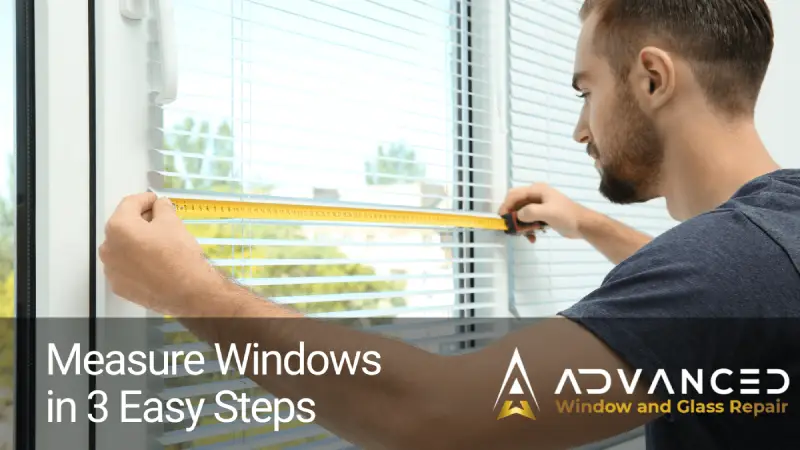
How do you measure a window for replacement? Most measurement errors come from one source: measuring the wrong thing. Homeowners measure the glass, the trim, or the exterior frame, and none of those give the right number.
The correct measurement is the rough opening, the space inside the frame where the new window sits.
Advanced Window & Glass Repair has served Northern Virginia, Maryland, and Washington DC for over 25 years as an NGA-certified glass company. This guide covers exactly how to measure for window glass replacement in Northern Virginia so the order is right the first time.
Why Getting the Measurement Right Matters
A measurement error of even a quarter inch can cause problems that cost far more than the window itself.
A replacement window that is too large will not fit through the opening. A window that is too small creates gaps around the frame where air, water, and insects enter freely. Either way, the window comes back, the installer returns, and the homeowner pays for at least one more service visit.
The U.S. Department of Energy guidance on energy-efficient windows notes that gaps and air leaks around window frames account for a significant share of residential heat loss. An accurate measurement is not just about fit. It is the foundation of everything the replacement window is supposed to deliver.
For older homes across Prince William County, Fairfax County, and the DC suburbs, the stakes are higher. Frames in homes built in the 1970s through the 1990s have settled over decades. What looked like a square opening at installation is often 3/8 of an inch or more out of square today. Measuring correctly accounts for that.
Tools You Need Before You Start
Gather these before measuring. Using the wrong tools is one of the most common causes of inaccurate results.
Metal tape measure (25 feet): Cloth or plastic tapes stretch over time and give inconsistent readings. A rigid metal tape holds its accuracy at every measurement point.
Notepad and pencil: Record every measurement immediately. Do not rely on memory, especially when measuring multiple windows in the same visit.
4-foot level: Use this to verify the sill and head jamb are level and the side jambs are plumb. An unlevel frame changes how the replacement window will sit and operate.
Flashlight: Poorly lit window wells in basements or north-facing rooms make it difficult to read measurements accurately.
Helper (recommended for large windows): A second person holds one end of the tape on a large bay, bow, or picture window openings to prevent tape deflection.
Understanding Window Anatomy
Knowing the correct terms makes the measuring process faster and prevents confusion when ordering. Advanced Window & Glass Repair uses these terms consistently across every estimate and order.
Head: The horizontal frame component at the top of the window opening. The new window’s top rail rests against it.
Jambs: The two vertical frame pieces on either side of the opening. Width is measured from the inside face of one jamb to the inside face of the other.
Sill: The horizontal component at the bottom of the opening. Height is measured from the high point of the sill to the low point of the head jamb.
Rough opening: The full space in the wall structure, including framing. This is relevant for new construction. Replacement windows fit into the existing finished frame.
Net opening (finished opening): The space inside the trim where the replacement window will actually sit. This is the measurement to record for ordering replacement windows. Most double pane window replacement units are ordered by net opening size.
The key distinction: replacement windows are sized by the net opening, not by the glass or the overall window dimensions. Measure the opening, not the glass being removed.
Step 1: Measuring the Width
Width is measured horizontally from the inside face of one side jamb to the inside face of the opposite jamb.
Take three separate measurements: one at the top of the opening, one in the middle, and one at the bottom. No two measurements should be from the same height. In a perfectly square frame, all three will match. In most settled Northern Virginia frames, they vary by an eighth to a quarter of an inch.
Record all three numbers. The smallest of the three is the ordering width. A replacement window sized to the smallest measurement will clear the narrowest point of the opening. A variation greater than a quarter inch across the three measurements means the frame has shifted and the installation will need shimming to compensate.
Write the width as a fraction rounded down to the nearest eighth of an inch. Never round up. A window that is even a fraction too large will not fit through the opening.

Step 2: Measuring the Height
Height is measured vertically from the high point of the sill to the low point of the head jamb.
Take three separate measurements: one on the left side of the opening, one in the center, and one on the right side. Measure from the sill itself, not from any interior trim or stool piece that sits on top of it. Advanced Window & Glass Repair technicians consistently find that homeowners add half an inch of height to their measurements by starting from the stool rather than the sill surface, which causes the replacement window to sit too high in the frame.
Record all three numbers. The smallest of the three is the ordering height. Apply the same rule as width: use the smallest number and round down to the nearest eighth of an inch.
A variation greater than a quarter inch across the three height measurements signals an uneven sill or head jamb. Note this during measurement and flag it when ordering.
Measure taken. Not sure what to order? The full process, from confirming measurements to sourcing and installing the right glass unit for the frame, is handled with a single call. Call (571) 351-3692 or schedule a free phone estimate and a technician will walk through the options before any work is committed.
Step 3: Checking the Frame for Square
A frame that is not square will cause a replacement window to bind, gap on one corner, or sit visibly crooked in the opening. Checking before ordering avoids a costly discovery on installation day.
To check for a square, measure diagonally from the top left corner of the opening to the bottom right corner. Record that number. Then measure from the top right corner to the bottom left corner. When both diagonal measurements are within a quarter inch of each other, the frame is square and a standard replacement window will fit correctly.
A difference greater than a quarter inch means the frame has racked out of square. This is very common in Northern Virginia homes. Brick colonial homes in Woodbridge, Burke, and Annandale built in the 1980s often show diagonal differences of a half inch or more. Dale City and Montclair townhouse communities are particularly prone to this because of shared wall settling over time.
An out-of-square frame does not always require frame replacement. Some replacement windows can be shimmed to fit the opening accurately. But it must be documented before ordering so the installation crew brings the right materials.
Step 4: Measuring the Depth
Depth is the distance between the interior trim and the exterior blind stop or brick mould. A standard replacement window requires a minimum depth of 3.25 inches to fit properly within the frame.
To measure depth, open the window and place the tape measure flat against the interior trim. Measure straight through to the exterior frame. A measurement under 3.25 inches means a standard replacement window will not fit without extension jambs or a different installation approach.
Depth issues are more common in Northern Virginia homes that have had exterior siding added over the original frame. A house that started with vinyl siding over wood sheathing over the original frame can lose an inch or more of effective depth. This is also a factor in older homes in Falls Church, Annandale, and Silver Spring where multiple layers of exterior material have built up over 50 or more years of ownership.
Measuring by Window Type
Double-Hung and Single-Hung Windows
Double-hung and single-hung windows are the most common window type in Northern Virginia homes. Measure the width at three points inside the jambs and the height from sill to head jamb at three points. Take the smallest of each. The measurement process is straightforward for this type because the opening is a standard rectangle.
Measure each window individually. Two windows in the same room that appear identical often have different measurements by an eighth of an inch or more. This is especially true in homes where original windows were replaced at different times.
Casement and Awning Windows
Casement windows hinge on the side. Awning windows hinge at the top. Both are measured using the same net opening technique: width from jamb to jamb at three heights, height from sill to head jamb at three points.
Check for an operator crank that extends into the interior. The crank hardware does not affect the opening measurement, but it does affect clearance for window treatments or furniture placed near the window.
Bay and Bow Windows
Bay windows project outward from the wall in three sections at angles. Bow windows use four or more sections in a curved arrangement. Measure each individual unit separately, not the combined span.
Also record the depth of each bay or bow unit and the angle at which the side units meet the center section. Bay and bow measurements are the one window type where a professional verification before ordering is strongly recommended. An error on a bay or bow means returning three or more custom-fabricated units.
Measuring for Glass-Only Replacement (When the Frame Is Sound)
Not every window problem requires full window replacement. A broken single pane, a failed double pane seal, or impact-cracked glass can often be resolved by replacing just the glass unit while keeping the original frame in place. This is a different measurement task from full window replacement and uses different dimensions.
For full window replacement, the measurement is the frame opening, measured jamb to jamb. For glass-only replacement, the measurement is the glass unit itself. The two numbers are not the same. Ordering glass to the frame opening dimensions will produce a pane that is too large to seat in the sash.
Single Pane Glass
Measure the existing glass pane at three widths (top, middle, bottom) and three heights (left, center, right). Record each measurement. Use the smallest of each set.
Subtract 1/8 inch from both the width and the height before ordering. This allows the new pane to seat into the glazing compound or vinyl channel without being forced. Round down to the nearest 1/8 inch. Never round up.
Double Pane IGU Replacement
A double pane window contains an insulated glass unit (IGU): a sealed assembly of two panes separated by a spacer bar. Measure the full IGU including the spacer bar on all sides. The spacer is part of the replacement unit and must be included in the dimension. Order to exact measured size. Do not apply the 1/8-inch deduction used for single pane glass.
Note the thickness of the existing unit before ordering. Standard Northern Virginia double pane IGUs typically run 5/8 to 1 inch thick. The replacement unit must match that thickness exactly to seat correctly in the sash and close properly.
This glass-only approach is the most common repair path for Northern Virginia homes with solid wood or vinyl frames that have otherwise held up well. When only the glass has failed, replacing the glass alone preserves the original frame and costs far less than full window replacement.
Common Measurement Mistakes Northern Virginia Homeowners Make
Measuring the glass instead of the opening. The glass in the existing window is always smaller than the opening. A measurement taken from glass edge to glass edge will produce an order that is too small for the frame.
Measuring from the exterior. Exterior trim, brick mould, and siding all extend beyond the actual frame opening. Measurements from outside the house consistently come in larger than the actual net opening. Always measure from inside.
Taking only one measurement per dimension. A single measurement captures one point on a frame that may vary across its length. Three measurements at different heights and widths find the narrowest point and prevent ordering a window that will not pass through the opening.
Assuming all windows in the house are the same size. This is rarely true, especially in Northern Virginia homes where windows have been replaced individually over the decades. Measure every single opening before placing an order.
Rounding up. When in doubt, round down to the nearest eighth of an inch. Replacement windows can be shimmed to fill a slightly small opening. They cannot be forced into an opening that is too narrow.
Forgetting the depth measurement. Homeowners who complete width and height measurements without checking depth discover the problem on installation day when the replacement window will not sit in the frame. Check depth on every window, particularly in older homes with multiple layers of exterior cladding.
When to Call a Professional Instead
Some measurement situations are beyond what a tape measure and notepad can resolve reliably.
A frame that is more than half an inch out of square needs professional evaluation before ordering. The opening may need reframing rather than a shimmed replacement window.
Visible rot, soft spots in the sill or jamb wood, or mould around the frame edges means the frame is structurally compromised. A replacement window ordered to current opening dimensions will not perform correctly once the damaged material moves further.
Bay and bow windows should always be professionally measured. The compound angles and multiple unit coordination require verification before fabrication begins.
Historic properties in Old Town Woodbridge, Occoquan, or any Virginia Historic District may have restrictions on replacement window materials and profiles. A professional familiar with local historic preservation requirements can confirm what is permissible before an order is placed.
Conclusion
Accurate replacement window measurements come down to four steps: measure width at three points and use the smallest, measure height at three points and use the smallest, check the frame for square, and confirm the depth clears the 3.25-inch minimum. Each step takes less than five minutes per window once the technique is clear.
For Northern Virginia homeowners in older homes with settled frames, the squareness check and the depth measurement are the two steps most often skipped. Both are the most likely to cause an expensive problem on installation day. Once the measurements are in hand, the repair vs replacement decision comes next. Our guide on window repair vs replacement covers that decision in detail. Advanced Window & Glass Repair provides free phone estimates and on-site measurement verification across Northern Virginia, Maryland, and Washington DC for homeowners who want a professional to confirm the numbers before ordering.
Advanced Window & Glass Repair serves Northern Virginia, Maryland, and Washington DC with same-day glass service and NGA-certified technicians. Call (571) 351-3692 for a free phone estimate or to have a technician verify measurements on site before placing any order.
Frequently Asked Questions
How do you measure a window opening for replacement?
Measuring a window opening for replacement requires four separate measurements. First, measure the width by placing the tape measure from the inside face of one side jamb to the inside face of the opposite jamb. Take this measurement at the top, middle, and bottom of the opening and record all three numbers. Use the smallest of the three for ordering. Second, measure the height from the high point of the sill to the low point of the head jamb. Take this measurement on the left side, in the center, and on the right side of the opening. Use the smallest of the three for ordering. Third, check for square by measuring diagonally from corner to corner in both directions. If the two diagonal measurements are within a quarter inch of each other, the frame is square. Fourth, measure the depth from interior trim to exterior frame to confirm a minimum of 3.25 inches of clearance. Record all measurements on paper immediately. Round each dimension down to the nearest eighth of an inch, never up.
Should you measure replacement windows from the inside or outside?
Always measure from inside the house. Exterior measurements are unreliable because exterior trim, brick mould, siding, and cladding all extend beyond the actual frame opening. A measurement taken from outside will consistently come in larger than the true net opening. The net opening, the space inside the trim where the replacement window will actually sit, is only accessible and accurately measurable from inside the home. Measuring from inside also allows direct access to the jambs, sill, and head for accurate three-point measurements. For Northern Virginia homes with brick exteriors, measuring from outside is especially problematic because the brick returns and exterior trim can add an inch or more to the apparent opening width compared to the actual frame.
What is the difference between rough opening and net opening for replacement windows?
The rough opening is the full opening in the wall structure, framed by the structural studs before any finishing. The net opening, also called the finished opening, is the space inside the window frame trim where the replacement window will actually sit. For replacement window orders, the net opening is the correct measurement to use. Rough opening measurements are used for new construction projects where windows are being installed in a freshly framed wall. Replacement windows go into an existing finished frame, so the relevant dimension is the net opening between the interior jamb surfaces. In most cases, the net opening is smaller than the rough opening by an inch or two because the frame trim takes up space on each side. Taking rough opening measurements for a replacement order will result in a window that is too large for the finished frame.
How much smaller should a replacement window be than the opening measurement?
Most replacement window manufacturers build in a standard clearance of one quarter inch on each side, covering both the width and the height. This means the replacement window unit itself is typically ordered to the net opening dimension, and the manufacturer accounts for installation clearance in the unit’s construction. Some installers deduct a quarter inch from both the width and the height before ordering to ensure clearance for shimming. The exact deduction depends on the manufacturer and the window style. When in doubt, consult with the glass company or manufacturer before placing the order. For Northern Virginia homes with out-of-square frames, additional shimming clearance may be needed. A frame that is a quarter inch out of square in one direction requires enough clearance in the opposite direction for the window to sit straight.
What happens if window measurements are off?
A replacement window ordered from incorrect measurements creates one of two problems on installation day. A window that is too large for the opening cannot be installed without cutting down the frame, which is a structural modification that adds significant cost and time to the project. A window that is too small for the opening leaves gaps on one or more sides where air, water, and insects can pass through the frame. Small gaps can sometimes be shimmed and sealed, but large gaps require sending the window back and placing a new order. Custom-fabricated windows, including bay and bow units, typically cannot be returned or exchanged. The cost of a measurement error on a custom order includes the full price of the original unit plus the cost of the replacement order. Measurement verification by a professional before ordering eliminates this risk.
Are there special measurement considerations for older Northern Virginia homes?
Yes. Older homes in Northern Virginia, particularly brick colonials and townhouses built between the 1970s and 1990s in communities like Woodbridge, Burke, Dale City, Annandale, and Falls Church, frequently have frames that have settled out of square over decades. The diagonal squareness check is essential for these properties because a standard replacement window ordered without a squareness check may sit visibly crooked in the frame or fail to close and latch correctly. Homes in these areas also commonly have multiple layers of exterior cladding added over the original build, which can reduce effective frame depth below the 3.25-inch minimum required for standard replacement windows. Extension jambs or a different installation approach may be needed. Homes in Northern Virginia Historic Districts, including parts of Old Town Woodbridge and Occoquan, may have restrictions on replacement window profiles and materials that require verification before ordering. For any home built before 1990 in the DMV region, a professional measurement confirmation before placing a window order is a practical safeguard.


)