
Patio door selection is something Advanced Window & Glass Repair’s team advises on regularly across Northern Virginia, DC, and Maryland. The type, material, and glass specification affect thermal performance, security, maintenance requirements, and service life.
The wrong choice for the specific opening creates problems that are expensive to correct once the door is installed. For sliding glass door repair and replacement and full patio door installation across the DMV area, the most common issue the team encounters is a door selected for appearance without enough consideration of the practical requirements of the opening. This guide covers every decision point.
Types of Patio Doors
The three main types of patio doors suit different opening configurations, room sizes, and use patterns. Choosing the wrong type for the specific application affects both function and cost.
Sliding glass doors are the most common patio door type in residential properties across Northern Virginia, DC, and Maryland. The door panel travels horizontally on a lower track, with one panel fixed and one movable in the standard configuration. Sliding doors require no floor space for the door swing, which makes them appropriate for openings where adjacent furniture, walls, or exterior features limit clearance. The movable panel opens to roughly half the total door width. They suit standard patio access openings in the 1,800mm to 2,400mm width range.
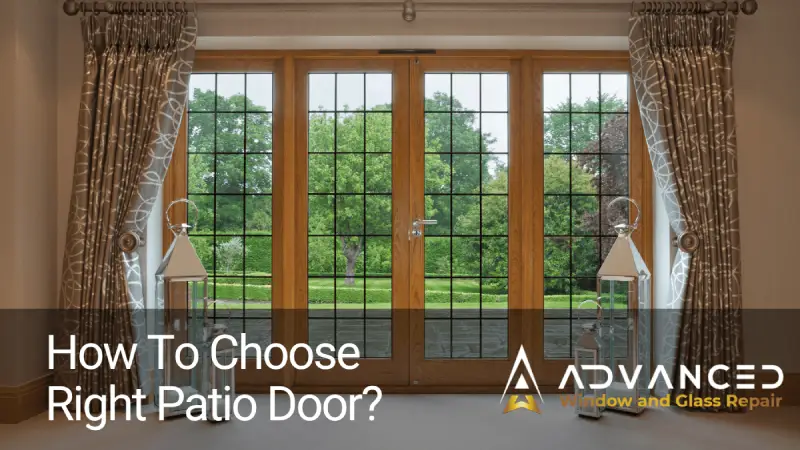
French doors are hinged on one or both sides and swing outward or inward when opened. They provide a full-width opening when both panels are open, which is useful for moving furniture, hosting outdoor events, or creating a visual connection between the interior and the outdoor space. The door swing requires clear floor space of approximately 900mm on the opening side. French doors suit larger openings and rooms with adequate clearance for the swing. They provide a more traditional aesthetic than sliding or folding types.
Bi-fold and multi-slide doors use multiple panels that fold or slide into a compact stack at one or both ends of the opening. When fully open, they provide an unobstructed opening across the full wall width. They are the most expensive of the three types and require the highest level of professional installation to set correctly on their tracks and hinges. They suit openings wider than 2,400mm where a full-width opening is the primary design objective.
For patio door glass replacement on any of these types, the glass specification for the replacement unit must match the original door’s structural and thermal requirements.
Choosing Based on Material
The frame material determines maintenance requirements, thermal performance at the frame edge, dimensional stability, and visual character.
Vinyl (uPVC) frames are the most widely specified material for residential patio door replacements in Northern Virginia. They require no painting, resist moisture and corrosion, and maintain their dimensions well through seasonal temperature swings. Colour options are more limited than timber or aluminium, but the range of white, cream, and woodgrain foil finishes covers most residential applications. Vinyl frames are the lowest maintenance option and the most cost-effective for standard residential openings.
Aluminium frames provide the slimmest profiles of any material, which maximises the glass-to-frame ratio and suits contemporary architectural styles. Aluminium does not rot or warp, and powder-coated finishes are available in any RAL colour. The trade-off is thermal performance at the frame edge. Aluminium conducts heat readily, which creates a thermal bridge unless the frame incorporates a thermal break (a non-conductive section separating the inner and outer aluminium profiles). Always specify aluminium with a thermal break for exterior patio door applications in the DMV climate.
Fiberglass frames are dimensionally stable, resistant to moisture, and available in wood-grain finishes that closely replicate timber without the maintenance requirements. They insulate better at the frame edge than aluminium and do not require the thermal break specification. They are more expensive than vinyl but less expensive than timber.
Timber frames provide the best frame insulation value and suit properties with timber windows and historical architectural character. They require periodic repainting or restaining of exterior surfaces. Timber patio doors in Northern Virginia typically need a repaint every five to seven years. The base rail and lower frame sections in contact with or near the threshold need particular attention, as moisture at the base accelerates deterioration.
Exterior glass doors in any frame material require proper flashing, drainage, and perimeter sealing on installation to prevent moisture ingress into the wall structure around the frame.
Energy Efficiency and Glass Specification
The glass unit accounts for the majority of the door’s thermal performance. Frame material contributes, but the glass specification has the larger effect on U-factor and overall energy efficiency.
The standard specification for a new patio door glass unit in the Northern Virginia, DC, and Maryland climate is double-pane Low-E with an argon gas fill. Low-E coatings reflect heat in both directions. In winter, the coating reflects interior heat back into the room. In summer, it reflects solar heat before it enters space. Argon gas fill slows heat transfer across the cavity, improving the unit’s overall thermal resistance.
Solar heat gain coefficient (SHGC) is the secondary specification to consider for patio doors in the DMV area. South and west-facing patio doors receive significant direct solar radiation during summer. A lower SHGC rating (0.20 to 0.30) reduces solar heat gain through those doors and lowers cooling demand during hot months. North-facing patio doors benefit from a higher SHGC rating (0.40 to 0.60) that captures passive solar heat in winter.
Triple-pane glass units provide additional thermal resistance but add significant weight to the door panel. In a sliding door, the added weight increases the load on the rollers and the track. Operational longevity can be reduced unless the hardware is upgraded to match. Triple-pane is appropriate for properties in exposed locations or where premium insulation performance is the priority. Advanced Window & Glass Repair advises on the glass specification appropriate for each specific opening as part of any patio door assessment.
Security Considerations
Patio doors are a primary target for forced entry because the large glass area and sliding panel configuration can be exploited if the locking hardware is inadequate.
Multi-point locking systems engage at multiple points along the door frame simultaneously when the handle is turned or the key is used. This distributes the locking force across the full frame height rather than concentrating it at a single latch point. Multi-point locks are standard on modern patio door systems and significantly increase the force required to force the door open.
Anti-lift devices prevent the door panel from being lifted off the lower track from outside. In sliding doors, the track channel provides enough clearance that a determined intruder can lift the panel free of the track by force if no anti-lift device is fitted. Anti-lift blocks or screws in the upper track channel above the door panel prevent this. This is one of the first security checks to make on any existing sliding patio door.
Impact-resistant glass (laminated glass with a PVB interlayer) holds together when struck rather than shattering into fragments. For patio doors in ground-floor or accessible locations, laminated glass prevents quick access through broken glass. Standard tempered glass breaks into small pieces on impact, which provides protection against laceration but does not prevent access through the opening.
Security bars and secondary locks provide additional resistance to forced entry. A track bar or pin lock fitted in the lower track channel prevents the door from being slid open even if the primary lock is defeated. These are inexpensive and take minutes to fit on any sliding patio door system.
Sizing and Opening Requirements
Getting the door size right before ordering prevents the costly situation of a door arriving that does not fit the rough opening.
The rough opening, which is the structural framing around the door, needs to be measured at multiple points. Wall framing in older properties often settles out of square over time. Measure the width at the top, middle, and bottom of the opening, and the height at both sides. The smallest measurement at each axis is the controlling dimension for door specification.
Standard sliding patio door widths in residential use are 1,800mm (approximately 6 feet), 2,100mm (7 feet), and 2,400mm (8 feet). Standard height runs from 2,100mm to 2,400mm. Non-standard opening dimensions require custom door sizes, which add to both the cost and the lead time.
For French door pairs, the rough opening needs to be wide enough for both panels plus the frame. Adequate clearance for the swing on the interior side is also required. A 1,800mm wide French door pair requires approximately 1,900mm of rough opening width to accommodate the frame. The door swing needs approximately 900mm of clear floor space per panel.
Choosing between sliding, French, and bi-fold patio doors involves the opening dimensions, the available clearance, the thermal specification for the wall orientation, and the security requirements of the specific property. Call (571) 351-3692 or get in touch with Advanced Window & Glass Repair via the contact page to book a patio door assessment across Northern Virginia, DC, or Maryland.
Security and Maintenance Considerations
Ongoing maintenance keeps a patio door operating correctly and extends the service life of the rollers, seals, and glass unit.
For sliding doors: Vacuum the lower track channel monthly during seasons of regular use. Apply silicone-based lubricant to the track and rollers twice a year after cleaning. Check roller height adjustment annually. Inspect the bottom sweep and perimeter weatherstripping before each heating season.
For French doors: Lubricate hinges annually with silicone spray. Check the multi-point lock mechanism and lubricate the cylinder with dry graphite or silicone spray. Inspect the perimeter seal on all four sides at the start of each heating season and replace any section that no longer makes full contact with the frame stop.
For bi-fold and multi-slide doors: Clean and lubricate the full track system twice a year. Inspect all pivot hinges and folding hardware annually. Bi-fold doors have more mechanical components than sliding or French types and require more comprehensive hardware maintenance.
Glass unit maintenance: Inspect the perimeter glazing tape and silicone sealant around the glass panel edge annually. Any section that has cracked or pulled away from the glass edge exposes the IGU seal to moisture. Reseal before the next wet season.
The U.S. Department of Energy guidance on air sealing covers how gaps at patio door frames and weatherstripping joints contribute to residential heat loss. It provides context for how door seal maintenance relates to measurable energy performance in properties where both heating and cooling costs are significant.
Conclusion
The right patio door depends on the available clearance, the opening width, the thermal specification, and the security requirements of the location. Sliding doors suit standard residential openings where floor clearance is limited. French doors suit wider openings where a full-width access is needed and floor space for the swing is available. Bi-fold and multi-slide doors suit large openings where the objective is removing the barrier between interior and exterior entirely.
Material and glass specification should follow the opening orientation and the architectural character of the property. For any patio door project in Northern Virginia, DC, and Maryland, an accurate site assessment before ordering prevents specification errors and installation problems. Advanced Window & Glass Repair carries out patio door assessments, supply and installation, and glass unit replacement for all door types across the DMV area. For a full guide on sliding door installation specifically, the patio glass door replacement solutions guide covers replacement options and the installation process in detail.
Advanced Window & Glass Repair handles patio door installation, glass replacement, and door assessment across Northern Virginia, DC, and Maryland. Call or reach out through the contact page to book a consultation or request a quote.
Frequently Asked Questions
Which type of patio door is most secure?
French doors with multi-point locking systems provide the highest resistance to forced entry because the lock engages across the full frame height and the solid frame surround the glass on all sides. Sliding doors are the most vulnerable if anti-lift devices are not fitted, since the panel can be lifted off the track. Any patio door type with laminated glass is more secure than one with standard tempered glass, since the interlayer holds the glass together after impact rather than clearing the opening immediately.
What is the most energy-efficient patio door type for Northern Virginia?
Energy efficiency depends more on the glass specification and weatherstripping quality than on the door type. A sliding door with triple-pane Low-E glass and a multi-seal frame performs better thermally than a French door with standard double-pane clear glass. For the Northern Virginia, DC, and Maryland climate, the minimum glass specification for a new patio door should be double-pane Low-E with argon fill. South and west-facing doors benefit from a lower SHGC to control summer solar heat gain.
How long do patio doors last?
A well-maintained patio door should last 20 to 30 years. The glass unit typically lasts 15 to 25 years before IGU seal failure becomes likely. The frame, hardware, and weatherstripping outlast the glass unit in most cases. Rollers in sliding doors are the hardware component with the shortest service life, typically 10 to 20 years depending on use frequency and maintenance. A patio door that is cleaned, lubricated, and has its weatherstripping replaced as needed will outlast one that receives no maintenance by a significant margin.
Can I replace just the glass in a patio door without replacing the frame?
Yes, in most cases. If the frame is structurally sound, the glass panel or IGU can be replaced without removing the door frame. A new glass unit is ordered to the correct dimensions, the failed unit is removed from the frame, and the replacement is fitted and sealed. This is significantly cheaper than replacing the full door and frame. It is the standard repair for fogged double-pane patio door glass, cracked panels, and glass units where the seal has failed.
What is the difference between a bi-fold door and a multi-slide door?
A bi-fold door uses panels that fold in pairs toward a fixed point at one or both ends of the opening, accordion-style. A multi-slide door has panels that stack behind each other at one end without folding. Multi-slide doors provide a cleaner visual when open because the panels sit flat rather than angled. Bi-fold doors are slightly more compact when open. Both create wide, unobstructed openings. Bi-fold doors have more pivot hardware per panel; multi-slide doors rely on track precision. Both require professional installation and regular hardware maintenance.


