
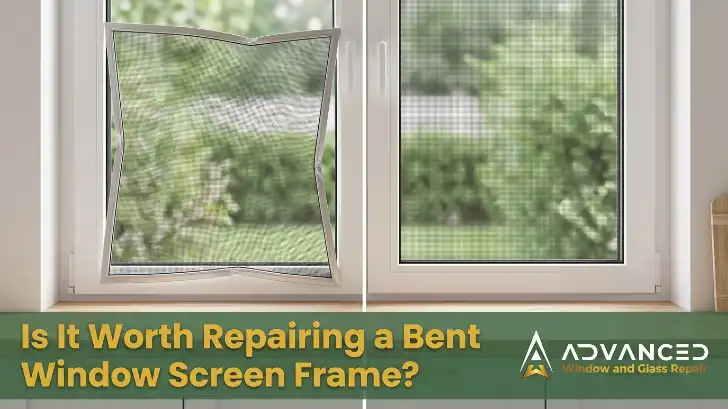
Screen frame damage is one of the more overlooked window maintenance calls the team at window repair services in Northern Virginia handles across Northern Virginia, DC, and Maryland. The decision comes down to the extent of the bend, the frame material, and whether the mesh is still intact.
In most minor cases, repair is the right call. In cases involving cracked corners or severe warping, replacement is faster and more cost-effective than repair. Advanced Window & Glass Repair covers both. This guide walks through every scenario.
Are Bent Screen Frames Repairable?
Most minor bends are repairable. The key question is whether the bend has caused permanent deformation or whether the frame material can still be straightened and hold its shape.
Slight bends caused by a single impact, such as a pet hitting the screen, furniture moved too close, or one-off wind pressure, are the most straightforward repair candidates. The frame material has not cracked or creased, and the mesh is still attached at the spline channel. Gentle, even pressure along the bend line restores the frame profile without stressing the corners or distorting the mesh tension.
Creased frames are a different situation. A crease is a point of concentrated deformation where the metal has permanently folded along a line rather than bowing gradually. Straightening a crease does not remove the structural weakness at that line. The frame will re-bend at the crease under far less force than the original damage required. Creased frames are better replaced.
Frames with cracked corners cannot be repaired. The corner joint is the structural anchor point for the whole frame. A crack at the corner means the frame can no longer maintain tension across the mesh. No amount of straightening restores corner integrity. Replacement is the only effective solution.
For properties with multiple screen frames needing assessment at once, home and commercial glass repair services cover screen assessment as part of broader window maintenance visits.
Frame Materials and Repair Potential
The material of the frame determines how well it responds to straightening and how long a repair will hold.
Aluminium frames are the most commonly used material in residential screen frames in the Northern Virginia area. Aluminium is malleable. It can be bent and straightened without cracking, provided the bend is not at a corner and has not created a crease. An aluminium frame with a simple bow along one rail can usually be straightened in minutes with basic tools. The material holds the correction well if done carefully.
Vinyl or plastic frames are more brittle than aluminium. They do not flex back to shape as aluminium does. Applying bending pressure to a vinyl frame that has already been bent risks cracking the material at or near the bend. If a vinyl frame is bent, the realistic options are replacement rather than repair in most cases.
Fibreglass frames are used in some higher-specification screen systems. They are more rigid than aluminium and do not bend easily, which means they are less susceptible to minor impact. When a fibreglass frame does bend, it is usually from significant force and the damage is rarely repairable.
Understanding the frame material before attempting any repair is important. Applying the techniques appropriate for aluminium to a vinyl frame causes cracking. The repair approach must match the material. Residential glass repair and screen assessment services across Northern Virginia, DC, and Maryland can confirm the frame material and the correct repair method for any specific window.
What Causes Window Screen Frames to Bend
Knowing the cause of the bend helps prevent recurrence and informs whether the specific damage is likely to be a one-off or part of a pattern.
Accidental impact is the most frequent cause. Pets jumping against screen doors or windows, furniture moved into contact with the screen, children playing near windows, and storm debris striking the screen during high winds all fall into this category. Most single-impact bends are minor and repairable.
Careless removal and reinstallation is the second most common cause. Screen frames fit into the window channel under spring or clip tension. Pulling a screen out of its channel at an angle rather than straight out applies lateral force to the frame rail. Over several seasons of removal and reinstallation, this accumulates as a gradual bow. Reinstalling a screen by pushing it into the channel with the corner rather than the full rail edge also stresses the corners over time.
Material fatigue in older screens causes progressive loss of dimensional stability. Aluminium frames that have been exposed to UV radiation and temperature cycling for many years become less springy and more prone to permanent deformation under the same forces that a new frame would handle without damage. A screen that bends easily from minor contact is showing material fatigue and is a replacement candidate rather than a repair candidate.
What the Repair Actually Involves
Straightening the frame: For aluminium frames with a simple bow or bend along a rail, straightening involves applying even, gradual pressure across the full length of the bend rather than at a single point. Working the frame back toward its original flat profile in small increments prevents over-correction and reduces the risk of creating a crease in the process. The frame should be checked for flatness on a flat surface after each adjustment. A frame that does not lie flat after straightening will not sit correctly in the window channel and will allow gaps at the contact points.
Spline replacement: The spline is the rubber or vinyl cord that runs around the perimeter of the screen frame and holds the mesh in the channel. Spline degrades over time. It dries, shrinks, and loses its grip on the mesh. A bent frame that is being repaired should have the spline inspected at the same time. Old or hardened spline that is not replaced will allow the mesh to pull away from the frame within one or two seasons even if the frame itself has been straightened correctly.
Mesh replacement: If the mesh has torn, stretched loose, or shows holes from the bending damage, it needs to be replaced as part of the repair. Attempting to straighten a frame with damaged mesh and reinstalling it provides limited benefit. The primary function, keeping insects out, is compromised by the mesh damage regardless of the frame condition.
DIY vs Professional Repair
| Factor | DIY Repair | Professional Service |
| Cost | Lower | Moderate |
| Risk of further damage | Higher | Lower |
| Frame alignment accuracy | Inconsistent | Accurate |
| Spline tensioning | Often incorrect | Correct |
| Time required | Higher | Lower |
DIY straightening of a bent aluminium frame is a reasonable approach for a minor bow with no crease and intact mesh. The primary risk in DIY repair is over-correction. Applying too much force to the bend creates a new deformation on the opposite side. Working slowly in small increments and checking flatness after each adjustment reduces this risk.
DIY repair is not appropriate for frames with cracked corners, heavily creased rails, or vinyl frames where the material may crack. It is also not appropriate when the mesh needs re-tensioning. Achieving correct mesh tension without proper spline rolling tools results in a loose or wrinkled mesh that allows gaps at the frame edges.
Advanced Window & Glass Repair handles screen frame assessment, straightening, and mesh replacement across Northern Virginia, DC, and Maryland.
When Replacement Is the Better Option
Some bent screen frames reach a point where further repair is not worth the time or cost. The clearest indicators are:
A crease along any rail that does not flatten under corrective pressure. The frame will re-bend at the crease.
Cracked or separated corner joints. These cannot be repaired to original strength.
A frame that has been bent and straightened multiple times. Each repair cycle reduces the material’s elasticity. A frame on its third or fourth repair will bend again more easily than a new frame.
Mesh that has been overstretched from the bending damage. Overstretched mesh cannot be re-tensioned correctly without replacement.
Replacement screen frames are inexpensive in standard sizes and widely available. Custom-sized frames take longer to source but are still significantly cheaper than a full window replacement. Replacing a screen frame that has reached end-of-repair-life is more cost-effective than repeated repair cycles.
If a screen frame is bent and the correct course of action is not clear from inspection, a professional assessment takes less than 15 minutes and gives a definitive answer. Call or get in touch with Advanced Window & Glass Repair via the contact page to book an assessment across Northern Virginia, DC, or Maryland and avoid spending money on a repair that will not hold.
Cost Comparison and Long-Term Maintenance
DIY screen repair costs are minimal, typically under $20 for a spline kit and new mesh if needed. The time cost is higher, and the risk of a second repair within a short period is significant if the frame condition is borderline.
Professional screen repair in Northern Virginia runs from $30 to $80 per screen. The range covers frame straightening only, spline replacement, or full mesh and spline replacement. Full screen frame replacement on a standard residential window runs from $30 to $120 depending on size and material.
| Service | Typical Cost (2026, Northern Virginia) |
| Frame straightening only | $30 to $50 per screen |
| Spline replacement | $20 to $40 per screen |
| Mesh and spline replacement | $50 to $80 per screen |
| Full frame replacement (standard size) | $50 to $120 per screen |
Long-term maintenance that reduces screen frame damage: remove screens at the end of summer and store them flat in a cool, dry location. Reinstall by inserting the full edge of the frame into the channel rather than the corner. Inspect spline annually and replace it before it hardens and begins to release the mesh. A screen that is properly maintained and stored will last significantly longer than one that remains in the window year-round and is removed carelessly at seasonal transitions. For a full reference on window maintenance by season, the U.S. Department of Energy guidance on weatherstripping covers the related topic of how weatherstripping and window seal maintenance affects overall energy performance and window longevity.
Conclusion
A bent window screen frame is worth repairing when the bend is a simple bow along a rail without creasing and the corners and mesh are undamaged. Aluminium frames handle straightening well when done carefully. Vinyl frames are better replaced in most cases because the material is too brittle to straighten reliably without risk of cracking.
When the frame has creased, cracked at a corner, or been bent multiple times, replacement is the more cost-effective decision. Screen frame replacement is inexpensive, and delaying it by repeated repair on a compromised frame costs more in total than a single replacement would have. Advanced Window & Glass Repair handles screen assessment, repair, and replacement across Northern Virginia, DC, and Maryland as part of broader window maintenance work. For guidance on the full range of window maintenance tasks and their recommended frequency, the window maintenance tips guide covers annual and seasonal checks for all window types.
Advanced Window & Glass Repair carries out screen frame repair and replacement as part of window maintenance work across Northern Virginia, DC, and Maryland. Call (571) 351-3692 or reach out through the contact page to book a visit or request a quote.
Frequently Asked Questions
Can I straighten an aluminium screen frame myself?
Yes, for a simple bow without a crease or corner damage. Work slowly, applying even pressure along the full bend line rather than pressing at a single point. Check flatness against a flat surface after each adjustment. Stop if the frame develops a crease during straightening. A creased frame needs replacement. For frames with cracked corners, torn mesh, or severe warping, DIY repair is not appropriate.
How do I know if the spline needs replacing?
The spline should be pliable and grip the mesh firmly in the channel. Run a finger along the spline: if it feels hard, brittle, or compressed flat, it has aged past effective use. If the mesh pulls away from the channel with light finger pressure, the spline has lost its grip. Replace the spline whenever the mesh is being re-tensioned or when the screen has been disassembled for any repair.
Why does my screen frame keep bending in the same place?
Repeated bending at the same location indicates either a crease from an earlier repair cycle that created a permanent weak point, or a design or installation issue that places repeated stress on that section of the frame. A crease that has been straightened once will always be weaker than the surrounding material and will re-bend under less force. If the frame keeps bending at the same spot, it should be replaced rather than straightened again.
Is it cheaper to repair or replace a screen frame?
For a single minor repair, DIY straightening costs almost nothing in materials. A professional repair on a single screen runs $30 to $80 in Northern Virginia in 2026. A full frame replacement runs $50 to $120. If the frame has been repaired more than once or has damage that makes repair likely to fail again quickly, replacement is more cost-effective over a one to two year period than another repair cycle.
How long does a screen frame repair last?
A well-executed straightening repair on a minor bend in a sound aluminium frame, with fresh spline and intact mesh, can last several years before the screen needs attention again. A repair on a frame with material fatigue or a previously creased rail may last only one season before the same area bends again. The condition of the material at the time of repair is the best predictor of how long the repair holds.


