
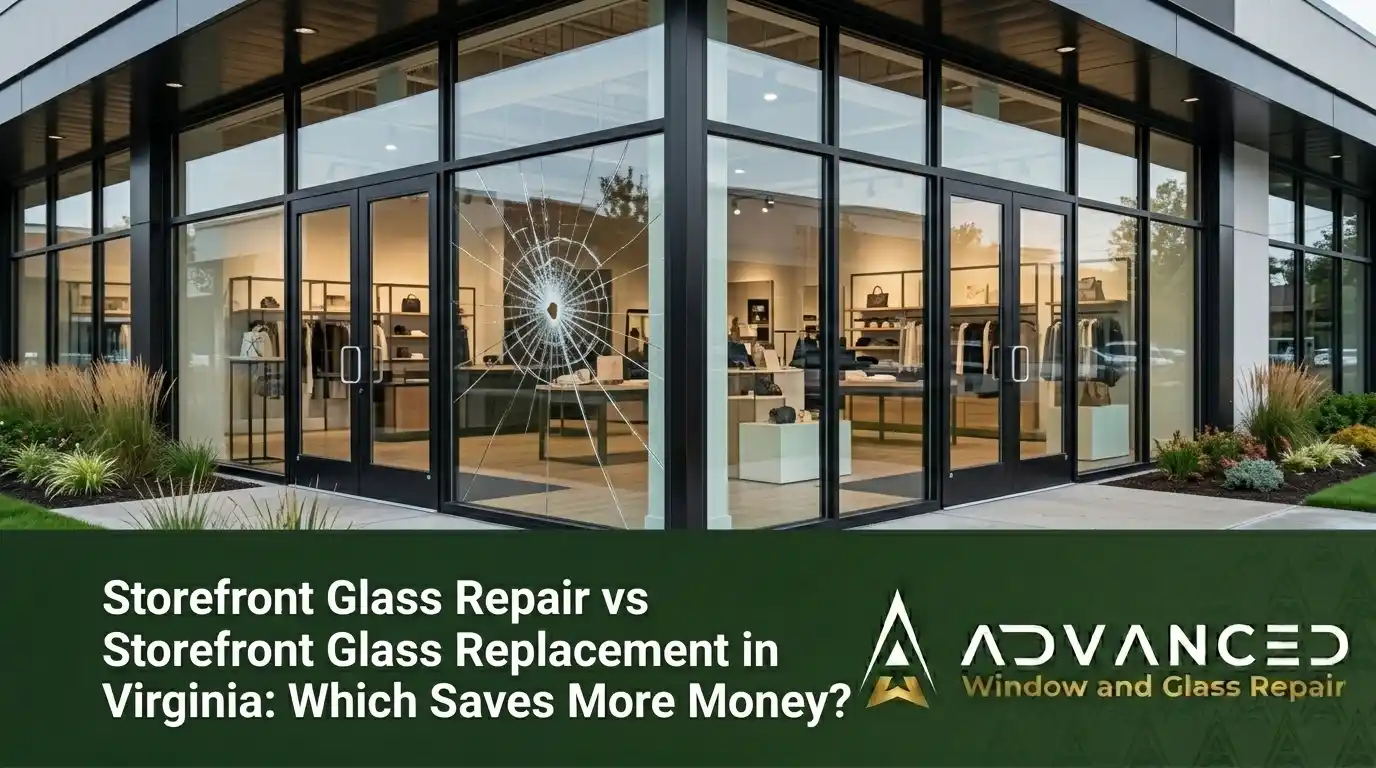
A broken storefront window at 7am, forty-five minutes before opening: that is the moment most business owners start searching. The question is not just which option costs less on paper. The question is not just which option costs less on paper. It is which option gets the business open fastest, satisfies the insurance claim correctly, and holds up long-term.
Advanced Window & Glass Repair has handled commercial glass calls across Northern Virginia since 1999. The answer depends on three things: the extent of the damage, the condition of the aluminium frame, and the type of glass involved.
This guide covers all three, plus verified 2026 pricing, the insurance process, Virginia code obligations, and a scenario-by-scenario decision table. Our storefront glass repair and replacement services cover every damage type described below.
Understanding the Two Options: What Repair and Replacement Actually Mean
The terms repair and replacement are used loosely in the commercial glass industry. Getting the definitions right helps business owners ask the right questions and avoid being upsold on work they do not need.
What Storefront Glass Repair Covers
Storefront glass repair means addressing damage to the glass itself without removing or replacing the aluminium storefront frame system. The most common repair scenarios are:
- Replacing a single broken or cracked glass panel within an existing aluminium frame that remains structurally intact
- Resealing a failed glazing bead where the glass has come loose from the frame channel
- Applying security film to a cracked panel as a temporary measure while a replacement panel is fabricated
- Replacing a broken glass door panel within the existing door frame and hardware
In each case the frame stays in place, the surrounding panels are undisturbed, and the work is completed in hours rather than days. Repair is the default starting point because it is faster, less expensive, and causes less disruption to business operations.
What Storefront Glass Replacement Covers
Storefront glass replacement means removing and replacing either the glass panels within an existing frame, or both the glass and the aluminium frame system together. The distinction matters because these are very different scopes of work.
Glass-only replacement within an existing frame covers situations where the entire panel must be removed rather than just resealed or patched. It is structurally identical to repair. The aluminium frame stays in place. This is the correct terminology when a panel is shattered completely.
Full storefront system replacement removes the aluminium framing, mullions, transoms, sill plates, and all glass panels. A completely new system is then installed. This is a construction project, not a glass job. It takes days, requires permits in most Virginia jurisdictions, and costs multiples of a glass-only replacement.
The Virginia Business Owner’s Frame Assessment: Repair or Replace?
The aluminium frame condition is the single most important factor in the repair vs replacement decision for Virginia businesses. Advanced Window & Glass Repair assesses the frame before quoting on every commercial job across Prince William County, Fairfax County, Arlington, and Stafford. Replacing glass into a compromised frame wastes both money and time.
Business owners in the Route 1 and Route 28 commercial corridors can use this framework before calling anyone. Our team also handles commercial glass repair in Woodbridge VA and across the wider Northern Virginia area with same-day availability.
When the Frame Is Sound: Repair Is the Right Call
The aluminium frame is structurally sound when:
- No visible bowing, warping, or separation at the corner welds or mullion joints
- The glazing channels are intact, clean, and capable of holding new setting blocks
- The frame sits plumb and square in the storefront opening
- No corrosion has penetrated through the anodised surface to the aluminium substrate
- The door frame and hardware operate correctly on any adjacent door panels
When the frame passes these checks, a glass-only repair or panel replacement is the cost-effective solution. A new panel fabricated to the opening dimensions, installed with fresh glazing tape and setting blocks, restores full weather seal, security, and appearance. The cost is a fraction of full system replacement.
When the Frame Is Compromised: Replacement Is Necessary
Full storefront system replacement becomes necessary when:
- The aluminium frame has buckled, twisted, or been forced out of square by an impact
- Corner welds have separated, allowing the frame to rack under wind load
- Corrosion has attacked the frame structure, particularly at the sill plate where water pools
- The frame is an older toggle-in or wet-glazed system no longer compatible with current glass specifications
- The frame sustained damage in the same incident that broke the glass (vehicle impact, forced entry, storm damage)
In these cases, installing new glass into the damaged frame will not restore structural integrity or weather performance. The frame must go. This scenario drives the highest costs and the longest downtime. It is also where business owners most need an honest assessment before any work begins.

Real Cost Comparison: Repair vs Replacement in Virginia 2026
Verified 2026 pricing from multiple sources covering Northern Virginia commercial glass work. Labor rates in Fairfax County, Arlington, and Prince William County run approximately 22 percent above the Virginia state average.
| Scope of Work | Typical 2026 Range (Virginia) | Timeline | Permit Required |
|---|---|---|---|
| Single panel repair (reglaze/reseal) | $150 to $400 | Same day | No |
| Single panel replacement (glass only, existing frame) | $400 to $1,200 | Same day to 2 days | No |
| Multi-panel glass replacement (existing frame) | $1,200 to $4,000 | 1 to 3 days | No |
| Tempered glass panel replacement | $500 to $1,500 per panel | 1 to 2 days | No |
| Laminated glass panel replacement | $600 to $1,800 per panel | 1 to 3 days | No |
| Emergency board-up (interim) | $200 to $600 | Same day / hours | No |
| Full storefront system replacement (glass and frame) | $5,000 to $20,000+ | 3 to 10 days | Usually yes |
| Full storefront system replacement (large commercial) | $20,000 to $50,000+ | 1 to 4 weeks | Yes |
The cost gap between glass-only work and full system replacement is not marginal. A single broken panel in an intact aluminium frame costs $400 to $1,200 to resolve. Replacing the entire storefront system for the same opening costs $5,000 to $20,000. For a business operating on tight commercial margins, that difference is significant. The frame assessment in Section 2 determines which range applies.
The Hidden Cost Competitors Never Mention: Business Downtime
Every commercial glass cost guide published by the competitors in this space focuses on the material and labour bill. None of them account for the cost that matters most to a business owner. That cost is lost revenue during the period the storefront is out of service.
A restaurant in a Woodbridge strip mall doing $4,000 in daily revenue cannot afford a three-day closure. A full storefront replacement takes that long to fabricate and install. A medical practice in Fairfax loses appointment revenue for every hour the entrance is boarded up. Patients who cannot access the building go elsewhere. A retail unit in a Prince William County shopping centre loses foot traffic for every day the storefront looks like a construction site.
Glass-only repair or panel replacement resolves most commercial glass damage within hours or, at most, a single day. The board-up goes up immediately after the incident. The replacement panel is measured, ordered, and installed as soon as the glass is fabricated. Standard tempered panel sizes are often available the same day. Business operations continue with minimal interruption.
Full storefront system replacement is a construction project. Demolition, new framing installation, glass fabrication, and finishing work take three to ten days for a standard single-bay storefront. For larger or more complex systems, lead times extend to two to four weeks. During that period the business is operating behind plywood, losing curb appeal, and in some cases unable to open at all.
That is why emergency business glass services exist as a distinct offering. The board-up secures the opening immediately. The repair or replacement assessment happens next. The goal is to restore normal operations as fast as technically possible, not to complete the most comprehensive scope of work.
How to Handle Insurance for Storefront Glass Damage in Virginia
Commercial property insurance typically covers storefront glass damage caused by sudden, accidental events: vandalism, vehicle impact, storm damage, and break-in attempts. Virginia business owners operating under a Business Owners Policy (BOP) generally have glass coverage built into the property section of the policy. Standalone commercial glass insurance riders are also common for businesses with high-value storefronts.
The claims process for storefront glass in Virginia follows these steps:
Document everything before any work begins
Photograph the damage from multiple angles, including close-ups of the break pattern, the frame condition, and any adjacent damage. Note the time and date. If the damage resulted from vandalism or forced entry, file a police report immediately. The insurance claim will require it.
Call the glass contractor before calling the insurer
A licensed commercial glass contractor provides a detailed written estimate. It separates labour, materials, glass specification, and any ancillary work. This estimate is the primary document the insurance adjuster will use. A vague quote does not support a claim. A detailed scope-of-work estimate does.
Understand what the policy covers
Most BOP glass coverage pays for like-for-like replacement. This means the same glass type, specification, and size as the damaged panel. Upgrades to laminated or impact-resistant glass are generally not covered unless the policy specifically includes enhancement coverage. The deductible applies per incident, not per panel.
Know that board-up costs are usually covered.
Emergency board-up is generally treated as a mitigation expense and covered under the commercial property section of a BOP, often without applying to the glass sub-limit. Request itemised invoicing from the contractor that separates board-up costs from glass costs.
Be aware of business interruption sub-limits
Some BOP policies include business interruption coverage that compensates for lost revenue during the period a covered loss prevents normal operations. For a storefront glass incident that forces closure, this coverage may apply. Review the policy’s waiting period and documentation requirements with the insurer before assuming coverage.
Virginia Commercial Code: What the Law Requires When You Replace Storefront Glass
Virginia adopts the International Building Code as its commercial construction standard. Storefront glass replacement in Virginia commercial properties is not a free choice of specification. The glass type, thickness, and installation method must comply with the requirements applicable to the opening. The IBC Chapter 24 Glass and Glazing standards define the performance and safety requirements that govern every commercial glazing installation.
The two requirements that affect most Virginia storefront glass decisions are these:
Safety glazing in hazardous locations. All storefront glass adjacent to walking surfaces, within 18 inches of door openings, and in any location where human impact is foreseeable must be safety-glazed. For commercial storefronts, this means tempered or laminated glass is the minimum specification across the entire glazed area. Plain annealed glass does not meet this requirement and cannot be used as a like-for-like replacement in a commercial storefront, regardless of what was originally installed.
Replacement glass must meet current standards. Virginia’s commercial code requires that replacement glass installed in an existing building meet the quality and installation standards applicable to new construction at the time of replacement. A business owner who replaces a shattered panel below current code creates a liability exposure. Non-compliance is also a breach of the commercial occupancy requirements.
Permits for full system replacement. Replacing the glass within an existing frame generally does not require a building permit in most Virginia localities, provided the frame opening dimensions and structural loading are unchanged. Replacing the entire storefront system including the frame requires a building permit in Fairfax County, Arlington County, Prince William County, and most other Northern Virginia jurisdictions. A licensed contractor will confirm permit requirements before starting work.
Advanced Window & Glass Repair handles emergency storefront calls across Northern Virginia 24 hours a day. Call (571) 351-3692 or get a free storefront glass estimate online.Same-day board-up and glass repair available.
Storefront Glass Damage Scenarios: Repair or Replace?
Business owners rarely describe their glass problem in technical terms. The following table maps common real-world damage descriptions to the correct scope of work.
| Damage Description | Correct Scope | Typical 2026 Cost (Virginia) |
|---|---|---|
| Single panel cracked, hairline to 12 inches, frame intact | Glass-only repair or panel replacement | $400 to $900 |
| Single panel shattered, frame intact and square | Panel replacement (glass only) | $500 to $1,200 |
| Multiple panels broken, frame intact | Multi-panel glass replacement | $1,200 to $4,000 |
| Panel cracked, frame bowed or out of square | Full system assessment, likely system replacement | $5,000+ |
| Vehicle impact, frame buckled | Full system replacement | $8,000 to $25,000+ |
| Vandalism, single panel, no frame damage | Emergency board-up then panel replacement | $600 to $1,500 total |
| Storm damage, multiple panels, frame intact | Multi-panel replacement | $2,000 to $5,000 |
| Glass fogging or seal failure (IGU storefronts) | IGU panel replacement | $600 to $1,800 per panel |
| Door glass broken, frame and hardware intact | Door panel replacement | $400 to $1,000 |
| Full system aged, multiple issues | Full storefront system replacement | $10,000 to $30,000+ |
Virginia Business Types and Their Typical Glass Decisions
The correct repair vs replacement decision also depends on the business type, the commercial corridor, and the operational priorities of the property.
Retail Strip Mall Units (Route 1, Route 7, Route 28 Corridors)
The majority of retail storefronts along Northern Virginia’s commercial corridors are in multi-tenant strip mall buildings owned by a landlord. When glass is damaged, the lease agreement typically determines who pays for repairs. Most commercial leases in Virginia make the tenant responsible for interior glass and the landlord responsible for the exterior storefront system. A broken panel that falls within the tenant’s responsibility is a glass-only repair or replacement. A frame system that has deteriorated through landlord neglect is a landlord obligation. Clarifying the lease responsibility before ordering repairs prevents disputes over who receives the invoice.
Restaurant and Food Service Storefronts
Restaurants operate on thin margins and cannot afford extended closures. A broken panel at a Woodbridge restaurant on a Friday afternoon needs same-day board-up and a next-morning glass replacement, not a week-long full system installation. Restaurants in strip mall units along Dale Boulevard, Minnieville Road, and Route 1 typically have standard aluminium frame systems. Off-the-shelf tempered panels are available for rapid replacement in most cases. Emergency response and speed of restoration matter more than comprehensive scope in these cases.
Medical and Professional Office Buildings
Medical practices and professional offices in Fairfax County, Arlington, and the Woodbridge medical corridor along Route 1 face a different consideration: patient and client perception. A boarded-up entrance signals instability to patients and clients walking past. The priority is restoring a professional appearance as fast as possible. Glass-only replacement with a matching clear tempered panel achieves this in one day. A full system replacement may need scheduling for a weekend or a lower-volume period. This avoids disrupting daily operations even when replacement is the better long-term solution.
Conclusion
For most Virginia business owners facing storefront glass damage, glass-only repair or panel replacement is the correct answer. It costs a fraction of full system replacement, restores operations the same day in most cases, and delivers equivalent performance when the aluminium frame is structurally sound. The frame assessment in Section 2 is the gate: if the frame passes, repair; if it fails, replace the system. The cost table in Section 3 sets realistic 2026 expectations, and the scenario table in Section 7 maps the decision for the most common damage types.
Full storefront system replacement is not an upsell to avoid. It is the correct answer when the frame has been structurally compromised. Installing new glass into a damaged frame is a short-term fix that will cost more to redo. Advanced Window & Glass Repair gives business owners an honest assessment of which scope applies before any work begins. Free phone estimates and 24-hour emergency response cover Northern Virginia, Maryland, and Washington DC. For glass door damage specifically, the commercial glass door repair guide for Woodbridge business owners covers door-specific repair and replacement decisions in detail.
Call (571) 351-3692 or request same-day commercial glass service across Northern Virginia. Advanced Window & Glass Repair is NGA-certified, locally owned since 1999, with 24-hour emergency response and free phone estimates.
Frequently Asked Questions
1. How much does storefront glass repair cost vs full replacement in Virginia in 2026?
Storefront glass repair and panel replacement in Virginia in 2026 runs $150 to $1,200 for most single-panel jobs. The final cost depends on glass type, panel size, and whether the existing frame is used. Multi-panel glass replacement within an intact frame runs $1,200 to $4,000. Full storefront system replacement runs $5,000 to $20,000 for a standard single-bay retail storefront. This includes demolition of the existing aluminium frame and installation of a new framing system with glass. Larger or custom systems cost significantly more. The critical variable is the aluminium frame condition. When the frame is structurally sound, glass-only replacement costs 60 to 80 percent less than full system replacement for the same opening. Northern Virginia labor rates run approximately 22 percent above the Virginia state average, reflecting the higher commercial market in Fairfax County, Arlington, and Prince William County.
2. How long does storefront glass repair take compared to full replacement?
Glass-only repair or panel replacement is typically completed within one business day for standard-dimension tempered glass panels. Emergency board-up can be installed within hours of the call, securing the opening while the replacement panel is measured and ordered. Many standard commercial tempered panel sizes are available from local stock for same-day or next-day installation. Full storefront system replacement is a multi-day or multi-week project. Demolition of the existing frame, installation of the new framing system, glass fabrication, and glazing take three to ten days for a standard single-bay storefront under normal conditions. For larger systems, custom framing, or permit-required work in jurisdictions with longer review times, the timeline extends to two to four weeks. For most Northern Virginia businesses, the downtime cost of full system replacement substantially exceeds the direct cost of glass and labour.
3. Can a cracked storefront window be repaired or does it always need replacing?
The answer depends on the crack type, size, and the glass specification. A hairline stress crack in a small section of a single tempered panel can sometimes be managed with a temporary security film application while the replacement panel is fabricated. However, any crack in tempered safety glass that compromises the panel’s integrity requires full panel replacement. Tempered glass cannot be cut or repaired in the field once the crack has formed. Laminated glass can sometimes tolerate a crack in the outer layer without immediate replacement if the interlayer remains intact. This is a temporary condition. The panel should be replaced promptly. Plain annealed glass cracks can occasionally be stabilised with resin injection for very small chips at the edge, but this is not a long-term solution for commercial applications. A licensed technician should assess any cracked commercial glass before the business decides to defer replacement.
4. Does commercial property insurance cover storefront glass damage in Virginia?
Most Virginia commercial property policies, including Business Owners Policies, cover storefront glass damage caused by sudden accidental events including vandalism, vehicle impact, storm damage, and break-in attempts. The coverage typically pays for like-for-like glass replacement, meaning the same specification and size as the damaged panel. Emergency board-up costs are generally treated as a mitigation expense and covered separately. Damage resulting from wear, deterioration, or maintenance neglect is not covered as it is classified as a maintenance issue rather than an insured event. Business interruption coverage for lost revenue during the closure period may apply under some BOP policies, subject to the policy’s waiting period and documentation requirements. Virginia business owners should document damage thoroughly before any work begins. Obtain a detailed itemised estimate from a licensed contractor. File a police report for vandalism or forced entry incidents. The insurance adjuster will use the contractor’s estimate as the primary basis for the claim.
5. Do I need a permit to replace storefront glass in Virginia?
Replacing glass within an existing storefront frame generally does not require a building permit in most Virginia localities. This applies where the frame dimensions and structural loading remain unchanged. It covers Fairfax County, Arlington County, and Prince William County. The work is classified as maintenance and repair rather than structural alteration. Full storefront system replacement, where the aluminium framing is removed and new framing is installed, requires a building permit in most Northern Virginia jurisdictions. Permit fees range from $50 to $300 depending on the locality and the scope of work. Historic districts, including parts of Old Town Alexandria and some designated commercial corridors in Fairfax County, may require additional review and approval before exterior work proceeds. A licensed commercial glass contractor will confirm permit status for the specific property and locality before starting work. The contractor can manage the permit application as part of the project.
6. Can my business stay open during storefront glass repair or replacement?
For glass-only panel replacement within an intact frame, most Northern Virginia businesses can remain open throughout the work. The technician installs a temporary board-up on the damaged opening and works without affecting the interior. The new glass panel is installed when the opening is ready. The total disruption to the interior is minimal. For full storefront system replacement, remaining open during construction is more complex. Demolition of the aluminium frame exposes the building opening to weather and creates a significant construction mess in the immediate area. Many businesses arrange for a temporary hoarding screen and schedule demolition phases outside trading hours, particularly for restaurants and medical practices where uninterrupted access matters. A contractor experienced in commercial glass work can schedule phases to minimise trading disruption and confirm the feasibility of remaining open for the specific storefront layout before work begins.


