
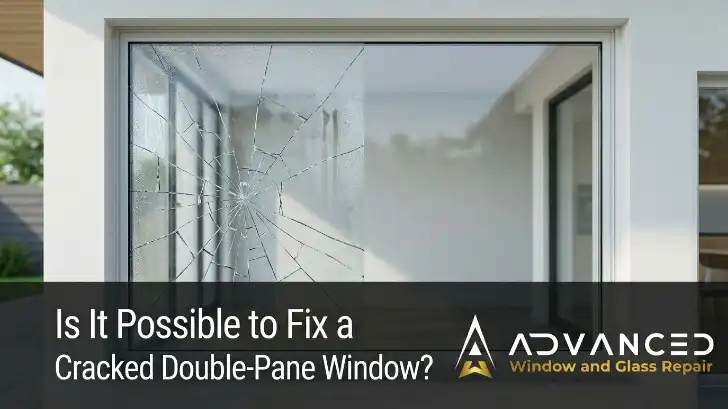
Most homeowners who call about a cracked double-pane window want one clear answer: repair or replace. The answer depends on what has cracked and where.
Double pane window repair and replacement calls to our team at Advanced Window & Glass Repair across Northern Virginia, DC, and Maryland most commonly result in either an IGU replacement or a full window replacement. True glass crack repair is rarely the right solution. This guide covers every scenario and the cost comparison between each option.
Understanding Double-Pane Windows
A double-pane window, commonly called an insulated glass unit (IGU), consists of two panes of glass separated by a spacer and hermetically sealed at the perimeter. The cavity between the panes is filled with either air or argon gas. Argon is denser than air and slows heat transfer across the gap, which improves the window’s overall thermal resistance.
The thermal performance of the window depends on two things: the integrity of the gas fill and the condition of the perimeter seal. When either is compromised, the window’s insulating performance drops.
Double-pane windows are rated by U-factor, which measures heat conduction through the unit, and R-value, which measures resistance to heat flow. A lower U-factor and a higher R-value indicate better thermal performance. A typical modern double-pane Low-E window has a U-factor between 0.25 and 0.35. A single-pane window has a U-factor ofapproximately 1.0. This gap explains the significant reduction in heating and cooling costs with double-pane glazing.
In Northern Virginia, DC, and Maryland, foggy window repair and glass replacement is the most frequent service on double-pane units. Most cases result from seal failure rather than impact damage.
Can a Cracked Double-Pane Window Be Repaired?
This depends on the nature of the crack and which part of the window has been damaged. There are three distinct scenarios, each with a different answer.
Surface cracks in the glass: A crack that runs through the glass pane itself cannot be permanently repaired. Resin fillers and crack repair kits can temporarily fill the crack and reduce the visual appearance of the damage, but they do not restore the structural integrity of the glass or the seal. The crack remains a point of weakness that is likely to propagate further with thermal cycling. The IGU needs to be replaced.
Seal failure without glass cracks: When the perimeter seal has failed, causing fogging or condensation between the panes, but the glass itself is undamaged, the IGU can be replaced without replacing the window frame. This is the most common professional solution for foggy double-pane windows. It restores thermal performance, clarity, and the original glass specification at a fraction of the cost of full window replacement.
Complete glass breakage: When one or both panes have shattered or broken into multiple pieces, the IGU must be replaced immediately. Broken glass in a frame is a safety hazard and the window provides no thermal or security function until the replacement unit is installed.
Our Residential glass repair Service covers all three scenarios across Northern Virginia, DC, and Maryland, with same-day assessment available for urgent situations.
What Causes Cracks in Double-Pane Windows
Understanding the cause helps prevent recurrence and informs the correct repair specification.
Thermal stress is the most common cause of cracks that start at the glass edge and run inward. When one part of the glass heats faster than another, differential expansion creates stress. A partially shaded window on a hot day, or a window with a radiator immediately below it, is particularly susceptible. Thermal stress cracks are straight, originate at the edge, and do not have a visible point of impact on the surface.
Impact damage from projectiles, hailstones, or storm debris creates a distinctive radial crack pattern spreading outward from the point of contact. The crack may or may not penetrate the outer pane depending on the size and speed of the object. Any impact crack that penetrates the glass surface compromises the IGU seal.
Frame stress occurs when the glass is installed too tightly in the frame without adequate clearance for thermal expansion, or when the frame shifts out of square. The glass cannot move with thermal expansion and the resulting pressure initiates a crack, usually perpendicular to the frame edge. Frame stress cracks are straight, run from the glass edge, and are often mistaken for thermal stress cracks. Checking the frame clearance before ordering a replacement IGU prevents recurrence.
Poor installation during original fitting is a separate cause. Setting blocks placed incorrectly concentrates stress at specific points on the glass edge. This type of crack usually appears within the first year of installation.
What Happens When a Double-Pane Window Cracks
The consequences of a cracked double-pane window depend on the extent of the damage, but the general effects are consistent.
Argon gas loss: A crack through the glass, or any breach of the IGU seal, allows the argon fill to escape. Once the cavity fills with ambient air, the thermal resistance of the window drops. For a standard argon-filled Low-E IGU, this reduces the window’s thermal performance noticeably. The reduction is measurable on energy bills over a full heating or cooling season.
Moisture ingress and condensation: Once the seal is breached, humid outside air enters the cavity. As temperatures drop, that moisture condenses on the interior glass surfaces, creating the fogging effect. Persistent fogging affects visibility and, over time, deposits mineral salts on the interior glass surfaces that cannot be cleaned from either side.
Reduced U-factor and R-value: A compromised IGU operates at a higher U-factor than its design specification. For a window rated at U-0.30, a failed seal can push real-world performance toward U-0.50 or worse. This increases heat transfer through the glass and raises heating and cooling demand.
Increased energy costs: A failed double-pane window forces the HVAC system to compensate for the additional heat loss or gain. In a well-insulated property with multiple failed windows, the cumulative effect on monthly bills is measurable.
Safety risk: A cracked outer pane is structurally weakened. Further impact, thermal stress, or wind loading can cause the pane to break completely and fall from the frame. This is a particular risk on upper floors or in exposed locations.
Repair vs Replacement: Your Options and Costs
There are three practical options for a cracked double-pane window. The correct choice depends on the type of damage and the condition of the frame.
Temporary crack repair (not a full solution): Crack fillers and resin injection kits are available for surface cracks. These temporarily reduce the visual appearance of the crack and may slow further propagation, but they do not restore the IGU seal, the thermal performance, or the structural integrity of the glass. Resin repairs on double-pane glass are a short-term measure at best.
IGU replacement (the standard professional solution): When the frame is structurally sound and the damage is limited to the glass unit and its seal, replacing only the IGU is the most cost-effective repair. The replacement unit is ordered to the exact dimensions and original glass specification, fitted into the existing frame, and sealed at the perimeter. This restores the window’s full thermal performance.
Full window replacement: Required when the frame is rotted, warped, or structurally compromised alongside the glass failure. Also required when upgrading from single-pane to double-pane, or when the window opening dimensions are changing.
| Option | Typical Cost (2026, Northern Virginia) | Thermal Performance | Longevity |
| Temporary crack repair | $20 to $80 DIY | Poor, not restored | Weeks to months |
| IGU replacement | $150 to $450 per unit | Fully restored | 15 to 25 years |
| Full window replacement | $400 to $800 installed | Best available | 20 to 30 years |
Advanced Window & Glass Repair assesses each window individually before recommending an option. The more expensive choice is not the default when the frame is sound enough to accept a new IGU.
DIY vs Professional Repair
Homeowners sometimes attempt to repair cracked double-pane windows themselves. The comparison below covers the key differences in outcome.
| Factor | DIY Attempt | Professional Service |
| Safety risk | High | Low |
| IGU seal restoration | Not possible | Standard outcome |
| Thermal performance | Not restored | Fully restored |
| Warranty on repair | None | Typically 1 to 5 years |
| Glass specification match | Unlikely | Matched to original |
DIY attempts at crack repair cannot restore the hermetic seal of an IGU. The tools and materials required to manufacture and seal a replacement IGU unit are not available to homeowners. Any crack that has penetrated the glass surface or compromised the perimeter seal requires a professionally fitted replacement IGU or full window replacement.
Before deciding between IGU replacement and full window replacement, a professional inspection takes less than 30 minutes and gives a definitive answer. Call (571) 351-3692 or get in touch with Advanced Window & Glass Repair via the contact page to book an assessment across Northern Virginia, DC, or Maryland and get an accurate quote before any work is committed to.
When Full Window Replacement Is Needed
IGU replacement is the right solution in most cases where the frame is structurally sound. Full window replacement becomes necessary in the following situations.
When the window frame is rotted, warped, or cracked alongside the glass damage. A new IGU fitted into a compromised frame will fail sooner than expected. The frame can no longer hold the unit at the correct pressure or provide a stable rebate for the glazing tape.
When the crack has damaged the frame hardware, including hinges, casement arms, or balance springs, to the point where the frame needs replacement anyway. In this situation, sourcing a matched replacement frame alongside the glass is often more cost-effective than replacing components separately.
When the window is original single-pane glazing and the homeowner wants to upgrade to double-pane performance. A single-pane frame cannot accommodate an IGU, so the full window including the frame needs to come out.
When multiple windows in the same property show simultaneous failure alongside frame deterioration. In this case, a planned full replacement project is more cost-effective over a three to five year period than sequential IGU replacements on failing frames.
The U.S. Department of Energy guidance on window replacement covers energy performance thresholds and U-factor benchmarks. It includes climate zone recommendations relevant to Northern Virginia, DC, and Maryland.
Conclusion
A cracked double-pane window is not always a full replacement situation. When the crack is in the glass and the frame is sound, IGU replacement restores full performance at a fraction of a full window replacement cost. When the frame has also failed, or when the crack is severe enough to compromise the structural opening, full replacement is the right call.
Getting an accurate assessment before committing to either option prevents spending money on a full replacement when an IGU swap would have been adequate. It also prevents fitting a new IGU into a frame that will fail again within two or three years. Advanced Window & Glass Repair carries out assessments and provides honest recommendations for homeowners across Northern Virginia, DC, and Maryland. For a more detailed guide on identifying IGU seal failure, the how to detect a broken window seal guide covers the signs of seal degradation before cracking becomes visible.
Advanced Window & Glass Repair carries out IGU replacement, cracked glass assessment, and full window replacement across Northern Virginia, DC, and Maryland. Call or reach out through the contact page to book an inspection or request a quote.
Frequently Asked Questions
Can a cracked double-pane window seal be resealed?
No. Once the perimeter seal of an IGU has failed or been compromised by a crack, it cannot be resealed from the outside. The IGU is manufactured as a hermetically closed unit. The only way to restore a proper seal is to replace the entire IGU with a new factory-sealed unit. Products that claim to reseal IGUs by injecting material through drilled holes provide temporary improvement at most and do not restore the original thermal performance.
How long can I leave a cracked double-pane window before replacing it?
A crack that has not yet reached the glass edge and has not progressed in several days can be monitored for a few weeks. Any crack that reaches the glass edge, spans both panes, or is accompanied by fogging between the panes needs attention promptly. A structurally compromised outer pane can break completely under further impact or thermal stress. This creates a safety hazard and leaves the opening without any thermal or security function.
Will my home insurance cover a cracked double-pane window?
This depends on the policy and the cause of the crack. Impact damage from storms, hail, or accidental breakage is often covered under standard homeowner policies. Thermal stress cracks and gradual seal failure are typically excluded as maintenance issues. Contact the insurance provider before attempting any repair or replacement, since DIY repairs may void coverage. Obtain a professional assessment and written quote before filing a claim.
What is the difference between a cracked IGU and a fogged IGU?
A cracked IGU has a physical break in one or both glass panes. A fogged IGU has no crack in the glass itself but has experienced seal failure, allowing moisture into the cavity and causing condensation between the panes. Both require IGU replacement, but for different reasons. A cracked IGU is a safety and security issue. A fogged IGU is a thermal performance issue. Both are typically resolved by the same repair: a new factory-sealed unit installed into the existing frame.
How do I prevent thermal stress cracks in double-pane windows?
Avoid placing objects directly against the glass surface that create shaded zones on a partially sunlit pane, such as furniture, blinds that cover only part of the glass, or reflective objects nearby. Maintain the external glazing seal around the glass edge, since a failed seal allows the frame to put uneven pressure on the glass. Check that the frame is properly vented if it is a timber frame, since an airtight timber frame can trap moisture that causes swelling and increased glass-edge pressure.


