
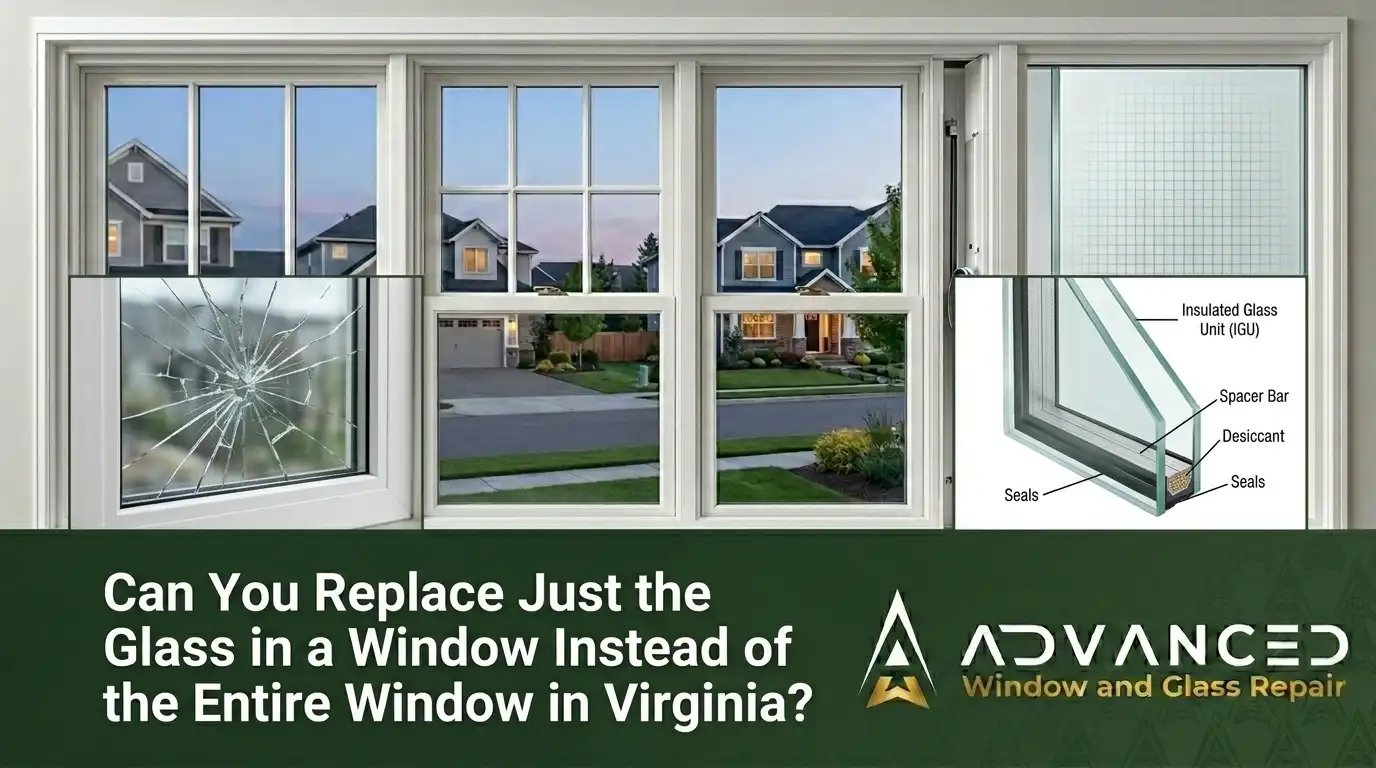
Most Virginia homeowners facing a cracked, foggy, or damaged window ask the same question: can you replace just the glass in a window instead of the entire window? The short answer is yes, in most cases.
Advanced Window & Glass Repair has operated across Northern Virginia, Maryland, and Washington DC since 1999, and the majority of residential glass calls result in a glass-only fix rather than a full window tear-out.
The deciding factor is frame condition. This guide explains exactly how to assess that, what glass options exist, what the work costs in Virginia in 2026, and when full replacement is genuinely the right call. Our glass replacement services in Virginia cover every scenario described here.
What Does “Replacing Just the Glass” Actually Mean?
Glass-only replacement means removing the damaged or failed glass from the existing window frame and installing new glass. The frame stays in place. The wall stays intact. There is no trim removal, no re-flashing, and no multi-week lead time.
The scope of the work differs depending on the window type.
Single-Pane Windows
Single-pane windows contain one layer of glass held in a frame by glazing compound or putty. Replacing the glass means cutting a new pane to size, removing the old putty, cleaning the channel, bedding the new glass, and resealing. It is straightforward work when the frame is sound. Single-pane glass is common in older Virginia homes built before the 1980s, particularly in historic neighborhoods across Fairfax County, Alexandria, and Fredericksburg.
Double-Pane and Triple-Pane Windows (IGUs)
Modern windows use insulated glass units, known as IGUs. An IGU is a sealed assembly containing two or three panes of glass with argon or krypton gas between them. The sealed unit sits inside the window frame. When an IGU fails through a broken seal, fogging, or a cracked pane, the technician removes the whole unit and installs a replacement. The frame and hardware stay in place. This is the most common glass-only repair in Virginia homes built after the 1980s, and it saves homeowners the most money compared to full window replacement.
How to Assess Your Window Frame Before Calling Anyone
Frame condition decides everything. A glass-only replacement only makes sense when the frame is structurally sound. Homeowners across Woodbridge, Fairfax, Arlington, and the wider glass repair and replacement in Northern Virginia service areas can run through this assessment before making a call.
Signs Your Frame Is Ready for Glass-Only Replacement
- The frame feels solid when pressed at the corners, with no flex or give
- No visible rot, soft spots, or dark staining on wood frames
- Vinyl frames show no warping, cracking, or separation at the corners
- The window opens, closes, and locks without binding or requiring force
- The frame sits square in the opening with consistent gaps at all corners
- No water staining on the sill or interior wall below the window
- Paint or finish is intact with no bubbling, peeling, or moisture blistering
If the frame checks all of these points, a glass-only replacement is likely the right call. A technician can confirm on inspection.
Signs the Whole Window Needs to Go
- Wood frame shows soft spots or dark rot when probed with a screwdriver tip
- Vinyl frame has buckled, bowed, or separated at the welds
- The window has shifted out of square and will not latch properly
- Drafts persist even with the window closed and locked
- Water has tracked into the wall cavity, not just onto the sill
- The frame is original to a home built before 1978 and has never been replaced
When any of these apply, replacing the glass alone will not solve the underlying problem. A new IGU installed into a compromised frame will fail sooner than expected, wasting the investment.
A Note on Historic Homes in Virginia
Virginia has a significant stock of historic homes, particularly in Old Town Alexandria, Occoquan, Old Town Woodbridge, Fredericksburg, and parts of Arlington. Homeowners in designated historic districts face additional considerations.
Many local preservation ordinances require that replacement glass match the visual character of the original, including thickness, texture, and in some cases the slight distortion characteristic of older glass. Standard modern float glass does not always satisfy these requirements.
A licensed contractor familiar with Virginia historic district rules can specify appropriate glass and liaise with the local preservation office before work begins.
When Glass-Only Replacement Works in Virginia Homes
Glass-only replacement is the right solution for the majority of damaged or failed windows in Northern Virginia homes, provided the frame qualifies. Advanced Window & Glass Repair runs a repair-first assessment on every job across Prince William County, Fairfax County, Stafford, and the wider DMV area. In most cases, the frame is sound and the glass is the only component that has failed.
The Frame Passes the Assessment
When a frame is structurally solid, square, and free of rot or moisture damage, there is no reason to replace it. Modern window frames are built to outlast multiple sets of glass. Replacing glass inside a healthy frame restores full performance at a fraction of full replacement cost.
The Damage Is Limited to the Glass or IGU
A single cracked pane, a failed IGU seal causing fogging between the panes, an impact fracture from a stone or hailstorm, a stress crack caused by Virginia’s freeze-thaw cycles: these are all glass-only problems. The glass failed. The frame did not. Replacing the double pane window repair and replacement unit resolves the issue completely. The new IGU restores thermal performance, eliminates fogging, and re-establishes the argon gas seal. Most jobs are complete within a few hours.
Glass-only replacement also extends the working life of the frame. A sound vinyl or aluminum frame can carry two or three successive IGUs across its lifespan. Replacing the frame prematurely discards a component that still has years of service remaining.
When the Whole Window Needs to Go
Glass-only replacement is not always the right answer. Specific conditions make replacing the entire window, frame, sash, and glass, the more practical long-term decision.
The frame is rotted, warped, or structurally compromised. Installing new glass into a damaged frame transfers the problem forward. The new glass will not seal correctly, drafts will persist, and moisture will continue tracking into the wall cavity.
The window is original to the home and approaching the end of its design life. Windows installed in Virginia homes built in the 1970s or early 1980s are now 40 to 50 years old. Even when the frame appears sound, the hardware, weatherstripping channels, and sash components are likely degraded beyond cost-effective repair.
The window does not meet current safety glazing requirements. Virginia’s building code mandates safety glass in certain locations: within 18 inches of a door, in bathrooms, on stairways, and in windows with sills within 18 inches of the floor. These locations require tempered or laminated glass. In some older configurations the existing frame cannot accommodate a code-compliant IGU, making a full replacement necessary.
Multiple systems are failing simultaneously. A window showing rot, seal failure, broken hardware, and a damaged sash has crossed the threshold where glass-only repair no longer makes economic sense. Full replacement at that point delivers better value than repairing each component separately.

Glass-Only vs Full Window Replacement: A Side-by-Side Comparison
| Factor | Glass-Only Replacement | Full Window Replacement |
|---|---|---|
| Average cost (Virginia 2026) | $150 to $600 per window | $700 to $1,600 per window |
| Time to complete | 1 to 3 hours per window | Half to full day per window |
| Frame requirement | Frame must be structurally sound | New frame included |
| Wall disruption | None | Trim removal, re-flashing required |
| Best for | Cracked pane, failed IGU, fogging | Rotted frame, major energy upgrade |
| Energy improvement | Significant with new low-E IGU | Maximum with full-frame unit |
| Permit required (Virginia) | Usually not | Often yes |
| Ideal window age | Under 20 years old | 20-plus years or compromised |
| Same-day completion | Yes, in most cases | Rarely, custom units have lead times |
| Historic home compatible | Yes, with appropriate glass spec | Depends on district rules |
What Glass Types Are Available for a Glass-Only Replacement in Virginia?
The glass type installed during a glass-only replacement determines thermal performance, safety rating, and long-term durability. The NGA industry standards for glass installation define the quality benchmarks that certified installers follow across every glass category.
Standard clear float glass is the baseline option for single-pane replacements and lower-specification IGUs. No special coating. Adequate for interior applications or secondary glazing where thermal performance is not the primary concern.
Low-E glass carries a microscopic metallic oxide coating that reflects infrared radiation. In Virginia’s climate, with humid summers regularly exceeding 90°F and winters with sustained freezing temperatures, low-E glass delivers meaningful energy savings year-round. It reduces summer heat gain and limits winter heat loss without affecting visible light. Low-E is the standard specification for most residential IGU replacements across Northern Virginia.
Argon-filled IGUs combine low-E glass with argon gas injected between the panes. Argon conducts heat less efficiently than air, improving the insulating value of the unit. Most replacement IGUs supplied for Virginia homes use argon fill as standard.
Tempered glass is heat-treated to be approximately four times stronger than standard glass. When broken, it fractures into small, relatively harmless granules rather than sharp shards. Virginia’s building code mandates tempered glass in hazardous locations: near doors, in bathrooms, on stairways, and in windows with sills close to the floor. Any glass-only replacement in these locations must use tempered glass.
Laminated glass bonds two glass panes around a plastic interlayer. It is harder to break than tempered glass and holds together when fractured rather than scattering. It also offers better noise reduction, which matters for Virginia homeowners near Interstate 95, the Fairfax County Parkway, or Reagan National Airport flight paths.
Triple-pane glass adds a third pane and a second gas-filled cavity. It offers superior thermal and acoustic performance. The cost premium over double-pane is substantial, and the additional weight requires a frame rated to carry it. A technician should confirm frame suitability before specifying triple-pane on a glass-only job.
Not sure which glass type fits your Virginia home? Our team at Advanced Window & Glass Repair gives free phone estimates across the DMV with no site visit required. Call (571) 351-3692 or contact us online for a straight answer on glass spec, cost, and timeline before committing to anything.
Virginia Pricing: What Does Glass-Only Replacement Cost in 2026?
Verified 2026 pricing from multiple sources shows consistent ranges across Northern Virginia. Final quotes vary by glass type, opening size, access difficulty, and number of windows.
| Job Type | Typical 2026 Range (Virginia) | What Drives the Price |
|---|---|---|
| Single-pane glass replacement | $150 to $350 per window | Pane size, glass thickness, putty work |
| Double-pane IGU replacement | $250 to $500 per window | IGU size, low-E coating, argon fill |
| Triple-pane IGU replacement | $400 to $700 per window | Unit weight, third pane, gas fill |
| Tempered glass replacement | $300 to $600 per window | Tempering process, size, safety cert |
| Full window replacement (comparison) | $700 to $1,600 per window | Frame material, style, installation |
Glass-only replacement costs 30 to 70 percent less than full window replacement for equivalent openings. On a typical Northern Virginia home with ten windows showing seal failure, glass-only IGU replacement runs $2,500 to $5,000 total. Full window replacement for the same ten openings typically runs $7,000 to $16,000.
Dominion Energy Virginia offers rebates for qualifying energy-efficient window upgrades. Homeowners replacing glass with ENERGY STAR-rated IGUs should check current Dominion Energy programs, as available incentives can offset a portion of material costs.
Pricing in Prince William County, Fairfax County, and Arlington tracks closely with the ranges above. Stafford County and outer Northern Virginia suburbs may see slightly lower labor rates. A free phone estimate gives an accurate number for most glass jobs without needing a site visit.
Do Permits Apply to Window Glass Replacement in Virginia?
In most Virginia jurisdictions, replacing only the glass or IGU inside an existing frame does not require a building permit. The work is classified as repair and maintenance rather than structural alteration. This applies across Prince William County, Fairfax County, Arlington County, and most Northern Virginia localities.
Permits are typically required when:
- The window opening is being enlarged or repositioned
- A non-egress window is being converted to an egress window
- The replacement changes the window to a fire-rated assembly
- The work is in a historic district requiring preservation approval
Alexandria’s Old Town historic district requires review and approval from the city’s Historic Preservation Program before exterior window work proceeds. Loudoun County and Arlington County require permits when structural modifications accompany the window work. Prince William County follows Virginia’s Uniform Statewide Building Code, under which glass-only IGU replacement inside an unchanged frame opening falls outside permit requirements.
A licensed Virginia contractor will confirm the permit status for the specific locality before starting work.
DIY or Professional: Which Makes Sense for Virginia Homeowners?
Single-pane glass replacement in a ground-floor window is within the capability of a careful homeowner with prior glass handling experience. The materials are accessible and the process is well-documented.
Several factors push the decision firmly toward professional installation for most jobs.
IGU replacement is not a DIY job. The sealed unit must be ordered to precise dimensions, handled with suction equipment to avoid stress fractures, and installed with correct setting blocks and edge clearances to prevent seal stress. An incorrectly installed IGU will fail within months, voiding the unit warranty and requiring the job to be redone.
Upper-floor glass carries real safety risk. A standard 24×36 inch double-pane IGU weighs 20 to 25 pounds. Working at height with glass on a ladder, without a second person and proper lifting equipment, is how serious injuries occur. Virginia townhomes and two-storey colonials, common across Dale City, Lake Ridge, Burke, and Springfield, have significant numbers of upper-floor windows where DIY glass work is genuinely hazardous.
Tempered and laminated glass cannot be field-cut. Both must be ordered to finished size. A homeowner who measures incorrectly loses the cost of the glass and the lead time. A professional measures precisely, orders once, and carries liability insurance if something goes wrong.
Professional installation also carries a workmanship warranty. If a new IGU fogs within the warranty period due to installation error, the contractor returns and rectifies it at no charge.
What the Glass Replacement Process Looks Like on the Day
Knowing what to expect removes uncertainty and lets homeowners plan around the work.
Call and free phone estimate
Most glass jobs can be quoted accurately over the phone from the window dimensions and a description of the damage. No site visit is required before booking in most cases. The estimate covers glass type, cost, and a realistic timeline.
Glass is measured and ordered
For IGU replacements, the technician may visit to measure the existing unit before ordering, particularly for non-standard sizes. Standard residential sizes are often stocked for same-day or next-day installation.
Day of installation
The technician arrives with the replacement glass, setting blocks, glazing compound or retention clips, and cleaning materials. Interior furnishings within a metre of the window are moved aside. The old glass or IGU is removed carefully, the frame channel is cleaned, and the new glass is seated, secured, and sealed. The work area is cleaned and the old glass is removed for safe disposal.
Inspection
The finished installation is checked for correct seating, even gaps around the perimeter, and a clean seal. On a standard double-pane IGU, the whole process takes one to two hours per window.
Most Northern Virginia glass replacements are completed the same day as the call, or within 24 to 48 hours for non-standard sizes.
Conclusion
The answer is yes: in most cases, homeowners can replace just the glass in a window instead of the entire window in Virginia. The frame assessment in Section 2 is the deciding test. Pass that assessment, and a glass-only replacement delivers full performance at a fraction of full replacement cost, with same-day completion and no disruption to the surrounding wall.
Full window replacement is the right call in specific circumstances: rotted or compromised frames, windows at the end of their design life, and situations where multiple systems are failing at once. Honest assessment of those conditions is what separates a repair-first contractor from one that defaults to full replacement because the ticket is larger. The guide on window repair vs full window replacement covers the full decision framework for homeowners weighing both paths.
Advanced Window & Glass Repair has built its reputation across the DMV since 1999 on this approach: assess first, replace only what needs replacing, and give homeowners a straight answer about which option serves them best.
Need broken or foggy window glass replaced fast? Advanced Window & Glass Repair has completed thousands of glass-only replacements across Northern Virginia, Maryland, and Washington, DC. Call (571) 351-3692 or Contact us Online for a free, no-obligation quote.
Frequently Asked Questions
1. Can you replace just one pane of glass in a double-pane window in Virginia without replacing the whole window?
Yes, in most cases. A double-pane window uses a sealed insulated glass unit, two panes bonded together as a single assembly with argon gas between them. When one pane cracks, or when the seal fails and causes fogging between the panes, the technician removes the entire IGU from the existing frame and installs a replacement unit. The frame, sash, and hardware all stay in place. This is a glass-only job, not a window replacement. It works as long as the frame is structurally sound, sitting square in the opening, and free of rot or moisture damage. The vast majority of double-pane window failures across Northern Virginia homes qualify for this type of repair. A cracked outer pane from a stone impact, a failed seal after Virginia’s freeze-thaw season, or fogging that develops gradually over years are all resolved by IGU replacement alone. The new unit is cut to the exact dimensions of the original, installed with the correct edge clearances, and sealed. Most jobs take one to two hours per window.
2. How do I know if my window frame is good enough to keep when replacing the glass in Virginia?
Run through a physical inspection before calling anyone. Press the corners of the frame firmly. It should feel rigid with no flex. On wood frames, probe any area showing discoloration or peeling paint with a screwdriver tip. Solid wood resists the probe. Rotted wood gives way easily. On vinyl frames, look for warping along the horizontal members and separation at the corner welds. Open and close the window: it should move smoothly and latch without lifting or forcing. Check the sill for water staining or soft material. Stand back and sight along the frame. It should sit square in the opening with consistent gap widths on all sides. If the frame passes all these checks, it is almost certainly a candidate for glass-only replacement. If any check fails, particularly soft spots in wood or a frame that has shifted out of square, a full replacement is the more cost-effective long-term solution. A licensed technician can confirm on a site visit when the assessment is unclear.
3. How long does a glass-only window replacement take compared to a full window replacement in Virginia?
A glass-only IGU replacement on a standard residential double-hung window takes one to two hours per window. A home with five failed IGUs can typically be completed in a single day. The work involves removing the old unit, cleaning the frame channel, installing the new IGU with setting blocks, and sealing the perimeter. There is no wall work, no trim removal, and no flashing. Full window replacement takes considerably longer: half a day to a full day per window depending on access and opening complexity. Multi-window full replacement projects often span two or more days. Lead time also differs significantly. Standard-size replacement IGUs are frequently available for same-day or next-day installation. Custom full window units typically carry a two to six week lead time from order to installation. For homeowners in Prince William County, Fairfax County, or Arlington who need a fast resolution, glass-only replacement is almost always the quicker path to a finished result.
4. Does replacing just the glass improve energy efficiency as much as a full window replacement in Virginia?
A glass-only IGU replacement with a current-specification low-E, argon-filled unit delivers the majority of the energy performance benefit. The glass and its coatings do most of a window’s insulating work. Upgrading from an older clear-glass IGU or a single-pane window to a modern low-E argon IGU produces a meaningful reduction in heat gain during Virginia’s hot summers and heat loss in winter. ENERGY STAR data suggests Virginia homeowners can save up to $236 per year on heating and cooling costs by upgrading to energy-efficient windows. A full window replacement adds the benefit of a new frame with improved weatherstripping and no thermal bridging through the original frame material. That incremental gain is relatively small compared to the glass upgrade itself. For homes with sound frames, a glass-only upgrade captures most of the energy benefit at a fraction of the cost. Full replacement makes more energy sense when the original frame is itself a major source of heat loss, typically in single-pane wood windows from the 1960s and 1970s where the weatherstripping has long since failed.
5. What glass types can I choose when replacing just the glass in a Virginia window?
The most common and cost-effective option for Northern Virginia homes is a low-E argon-filled double-pane IGU. The low-E coating reflects infrared radiation, keeping homes cooler in summer and reducing heat loss in winter. Argon gas between the panes adds insulating value over a standard air-filled unit. For windows near doors, in bathrooms, on stairways, or with sills within 18 inches of the floor, Virginia’s building code requires tempered glass. Tempered glass is heat-treated to be significantly stronger than standard glass and breaks into safe granules rather than sharp shards. Homes near major roads, such as those along Route 1 in Woodbridge, Interstate 66 in Fairfax, or within flight paths near Reagan National Airport, benefit from laminated glass, which adds a plastic interlayer that significantly reduces exterior noise. Triple-pane IGUs are available for maximum thermal and acoustic performance but come at a higher cost and require confirmation that the existing frame can carry the additional weight. Historic district properties in Alexandria, Occoquan, or Fredericksburg may need glass that matches the visual character of the original, including thickness and slight surface texture. A licensed installer will advise on the right spec for the opening, the home’s location, and any applicable code requirements.
6. Is glass-only window replacement covered by homeowners insurance in Virginia?
It depends on the cause of the damage and the specific policy terms. Sudden, accidental damage from a stone thrown by a lawnmower, a baseball, storm-driven debris, or a break-in is typically covered under the dwelling section of a standard HO-3 policy, subject to the deductible. Damage caused by gradual deterioration, seal failure, or age-related fogging is not covered, as insurers classify these as maintenance issues rather than insured events. Virginia homeowners in areas prone to hailstorms, common in Fairfax County and Prince William County during late spring and summer, should review their policy’s glass and glazing exclusions, as some policies exclude hail damage to glass specifically. Filing a claim is worth considering when the repair cost exceeds the deductible by a meaningful margin. For smaller single-window repairs where the cost is close to or below the deductible, paying out of pocket avoids a claim that could affect future premium rates. A professional glass contractor can provide a detailed written estimate suitable for an insurance claim when coverage applies.


